
When I got my genetic panel back and found out I have seven methylation mutations (MTHFR, MTR, MTRR, CBS, COMT, VDR, MAT1A), my first reaction was frustration. My second reaction was the question everyone asks:
Why would this even exist?
Why would evolution produce a gene that reduces my ability to convert folate by 70%? Why would it give me impaired B12 recycling? Why would it make detoxification harder? It feels like a manufacturing defect. Like somewhere in the production line, quality control fell asleep.
But that question, “why would evolution do this?”, is a category error. It reveals a broken mental model of how evolution actually works. And I think fixing that mental model matters, not just philosophically but practically, because it changes how you respond to your own genetics.
The Wrong Fitness Function
The first mistake. When people ask “why would evolution allow this mutation?” they're implicitly assuming that evolution is trying to produce a healthy, long-lived, optimally-functioning human. It's not. Evolution has one objective function and it's brutally narrow:
Did you survive long enough to reproduce, and did your offspring survive long enough to reproduce?
That's it. That's the entire loss function. Evolution is not optimizing for you feeling great at 40. It's not optimizing for you avoiding autoimmune disease at 31. It's not optimizing for longevity, cognitive performance, energy levels, or any of the things we actually care about when we talk about health. It's optimizing for one thing: reproductive fitness across generations.
This means a gene that gives you an autoimmune condition at 35 but makes you slightly more fertile at 18 is a winning gene. A mutation that causes chronic fatigue in middle age but conferred some survival advantage during famine at age 12 gets passed on. A variant that tanks your methylation capacity but maybe, just maybe, provided some other edge in an ancestral environment? Evolution doesn't care about the tradeoff. It already got what it wanted: your ancestors reproduced.
If you've worked on RLHF, you've seen this exact failure mode. You train a reward model on human preferences, then the policy finds some degenerate output that scores high on the reward signal while being obviously worse. Reward hacking. Goodhart's Law. The model optimized exactly what you told it to optimize. Everything else is a side effect. Evolution is running the same play, just over millennia instead of gradient steps.
There's a concept in evolutionary biology called antagonistic pleiotropy. It means a single gene can have beneficial effects early in life and harmful effects later. Evolution selects for the early benefit because that's when reproduction happens. The late-life cost is invisible to natural selection because by then you've already passed your genes on. This is potentially why aging exists at all. Evolution didn't fail to solve aging. It has no incentive to. The fitness function doesn't extend past reproduction.
So when I look at my MTHFR variant and ask “why?” the honest answer is: evolution doesn't owe me an explanation. It wasn't trying to build a perfect Nick. It was running an optimization loop with a very narrow objective, and my methylation capacity wasn't in the loss function.
Which One Is the Mutation?
The second category error is the one that really messed with my head.
When you get a genetic report that says “MTHFR mutation,” the framing implies that there's a “normal” version of the gene and you got the broken one. But think about what MTHFR actually does. It processes folate, the natural form of vitamin B9 that exists in leafy greens, liver, legumes. Foods that humans have eaten for hundreds of thousands of years. MTHFR handles folate just fine. It's been doing that job since before we were human.
What it doesn't handle well is folic acid, the synthetic form that was invented in a lab and added to enriched flour, bread, cereal, and pasta starting in 1998 in the United States. That's 28 years ago. Our species is roughly 300,000 years old.
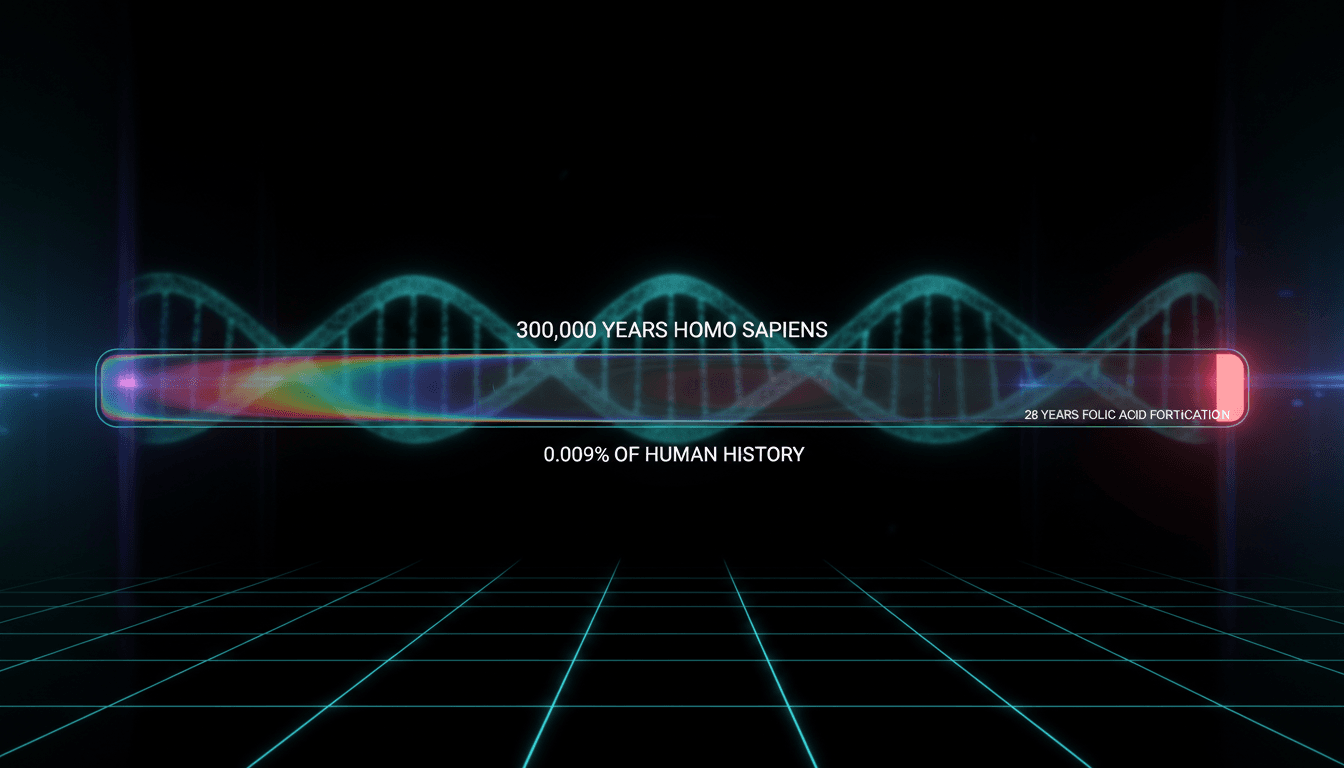
So which is the mutation? Is my MTHFR variant “broken”? Or is the ability to efficiently process a synthetic compound that's existed for 0.009% of human history the newer adaptation, and I just didn't get it?
Calling my MTHFR variant a “mutation” is a framing artifact. It depends entirely on which version you define as the baseline. If the baseline is “modern Western human who eats fortified food,” then yeah, I have a mutation. If the baseline is “human who eats the diet our species evolved on,” then my gene is the original and the ability to handle synthetic folic acid is the derived trait.
It's like calling someone “lactose intolerant” when lactose intolerance is the ancestral default for our species. The majority of humans on Earth can't digest lactose past childhood. Lactose tolerance is the mutation. It appeared roughly 7,500 years ago in European pastoral populations who domesticated cattle. We just call it “normal” because the people who named it could drink milk.
The framing determines the narrative. “You have a mutation” sounds like you're defective. “Your gene is the ancestral version and the modern environment changed around it” sounds like the environment is the problem. Both descriptions point at the same biology. Only one of them makes you feel broken.
Mutations Are the Search Algorithm
The third mistake is thinking mutations are errors, that they're something that went wrong. The correct mental model comes straight from machine learning.
Evolution is an optimizer. It's searching through an astronomically large space of possible genetic configurations to find ones that produce organisms fit enough to reproduce. But unlike anything we train in ML, evolution has no gradient. No backprop. No loss landscape to descend. It can't compute the derivative of fitness with respect to any gene.
So how does it search?
Random perturbation. Mutations are how evolution explores the search space. Every generation, the genome gets slightly randomly modified. Most mutations are neutral. Some are harmful. A tiny fraction are beneficial. Natural selection then acts as the filter: organisms with harmful mutations are less likely to reproduce, organisms with beneficial mutations are more likely, and over time the population drifts toward higher fitness.
If you work in ML, you've seen this exact pattern:
- Temperature in LLM sampling. When you set temperature to zero, you get the single most likely token every time. Deterministic, repetitive, boring. Raise the temperature and you get diversity, creativity, occasionally nonsense. The randomness isn't a bug in the decoder. It's the mechanism that produces novel outputs. Evolution's mutation rate is its temperature parameter.
- Regularization. Dropout, weight decay, data augmentation. We inject noise and constraint during training specifically to prevent overfitting, to keep the model from memorizing the training set and collapsing on out-of-distribution inputs. Genetic diversity is the species-level equivalent. A population with no variation has memorized one environment. The next shift wipes it out.
- Entropy bonuses in RL. When you train a policy, you add an entropy term to the loss to prevent premature convergence. Without it, the agent collapses to a single strategy and never discovers better ones. Evolution does the same thing. Mutations are the entropy bonus. They keep the species from collapsing to a single genotype.
My MTHFR variant isn't an error in the system. It's a sample from the system. Evolution rolled the dice on my genome, the same way it rolls the dice on every genome, because that rolling is what allows the species to adapt over time. Some rolls produce variants that are well-suited to the current environment. Some don't. But you need all of the rolls for the search to work.
A species with zero genetic variation is a species that can't adapt. The next environmental change (a new pathogen, a climate shift, a dietary change) wipes it out. Variation is the raw material that selection acts on. High variance in the population is what allows evolution to hill-climb over time. My seven methylation mutations are just points in that high-variance distribution. They're not defects. They're data points in the search.
The Distribution Shift Problem
In machine learning, distribution shift is when the data your model encounters in production is different from the data it was trained on. Every LLM with a training cutoff date demonstrates this. Ask GPT about something that happened after its training data ends and it either hallucinates or says it doesn't know. The model isn't broken. The world moved past its training distribution.
That's exactly what happened to my genes. My MTHFR variant was “trained” (selected for, or at least not selected against) in an environment of wild-caught food, natural folate, no synthetic folic acid, no processed grains, no industrial seed oils, no antibiotics, no chronic psychological stress, and significantly more microbial exposure. The gene configuration worked well enough in that environment for hundreds of thousands of years.
Then the environment shifted. Dramatically. In the last 100 years, a blink in evolutionary time, we introduced synthetic food fortification, antibiotics, chronic stress, sedentary lifestyles, processed food, and a thousand other environmental inputs that our genome has never seen. My genes didn't change. The distribution did.
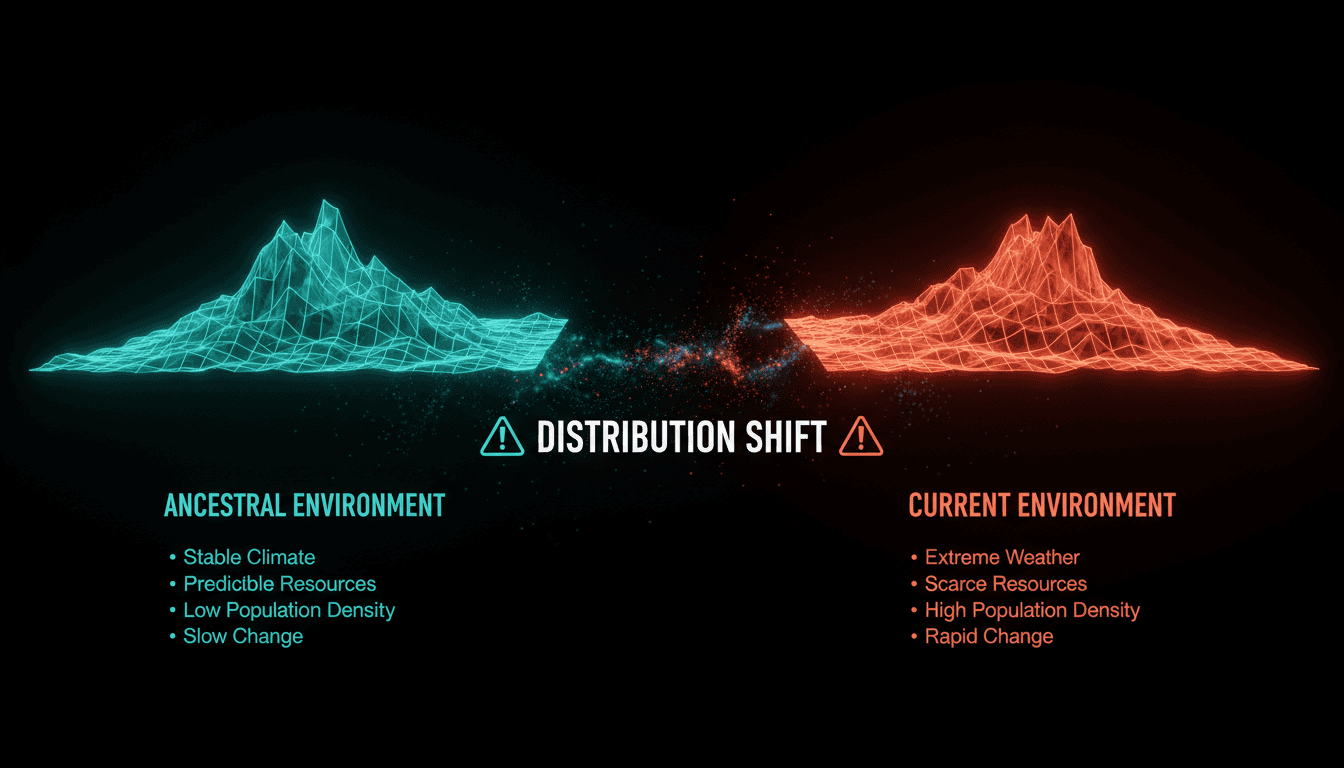
Asking “why would evolution give me this mutation?” is like deploying a model into a completely different environment and then blaming it when it underperforms. Your production environment is nothing like your training environment.
The Tradeoffs You Can't See
Once you have the right mental model, you start noticing the tradeoffs everywhere.
Sickle cell trait. One copy of the sickle cell gene protects against malaria. Two copies give you sickle cell disease. If you only look at the disease, it's a horrible mutation. If you look at the full picture, it's a brilliant adaptation in malaria-endemic regions. Heterozygous advantage: one copy is better than zero copies or two copies. The “bad” gene persists because it's beneficial at the population level.
COMT slow metabolizer. I have this one too. COMT clears catecholamines (dopamine, norepinephrine, epinephrine) from the brain. A slow COMT means I clear stress hormones more slowly, which is bad for anxiety and stress tolerance. But it also means higher baseline dopamine, which is associated with better working memory, sustained attention, and cognitive performance under calm conditions. Some researchers call it the “warrior vs. worrier” gene. In an ancestral environment where sustained focus during tracking or foraging could mean the difference between eating and starving, the “worrier” variant might have been an advantage. The same gene that makes me stress-sensitive also makes me detail-oriented. Evolution doesn't pick sides. It picks whatever reproduces.
Cystic fibrosis carriers. Carrying one copy of the CF gene (which causes severe lung disease in people with two copies) may protect against cholera and typhoid fever. Same pattern as sickle cell. The “disease gene” is actually a defense mechanism at half dosage.
MTHFR itself. We don't fully understand the tradeoffs yet. But given how common MTHFR variants are (roughly 40–50% of the population carries at least one copy), it's hard to argue it's a straightforward deleterious mutation. Variants that common in a population usually persist because they confer some advantage, or at minimum because they're not harmful enough in the ancestral environment for selection to remove them. The harm only becomes visible in the modern environment, which, again, is a distribution shift, not a genetic defect.
How This Changes What You Do
The mental model you apply to your genetics changes your response to them.
If you think your genes are “broken,” your response is helplessness. I got a bad roll. I'm defective. There's nothing I can do. That framing leads to either giving up or obsessively trying to “fix” your genetics, which you can't.
If you understand that your genes are the ancestral version operating in a mismatched environment, your response is different. The genes aren't the problem. The environment is. And unlike your genome, you can change your environment.
My MTHFR variant can't efficiently convert synthetic folic acid. So I don't eat synthetic folic acid. I take methylfolate (the already-converted form) and eat foods rich in natural folate. Not fixing a defect. Adjusting the environment to match the hardware.
My COMT variant clears stress hormones slowly, so I manage my stress inputs more carefully. L-theanine, magnesium, structured recovery. Different configuration, different operating conditions.
My VDR variant makes me less sensitive to vitamin D. So I take more of it, 5,000 IU daily instead of the standard 600 IU recommendation. I'm compensating for a gene that evolved in high-UV equatorial environments and now operates in San Francisco fog. The gene is fine. The latitude is wrong.
Stop asking “why would evolution give me this?” Start asking “what environment does my genome expect, and how far am I from it?” The gap between your genetic expectations and your actual environment is where disease lives. Close the gap and you fix the mismatch.
The Right Question
Evolution doesn't care if you feel good or live long or understand it. Once you've served its purpose, you're on your own.
The question isn't “why am I broken?” It's “what does my hardware actually need to run well, and am I giving it that?”
Probably not. Most of us aren't. But at least now you're asking the right question.