The AI Biohacker's Playbook
Make sense of your labs. Get the 10 AI prompts.
Drop your email and I’ll send you the guide.
Turn bloodwork, genetic results, and supplement bottles into a ranked list of what to check next. Copy the prompts and check every source.
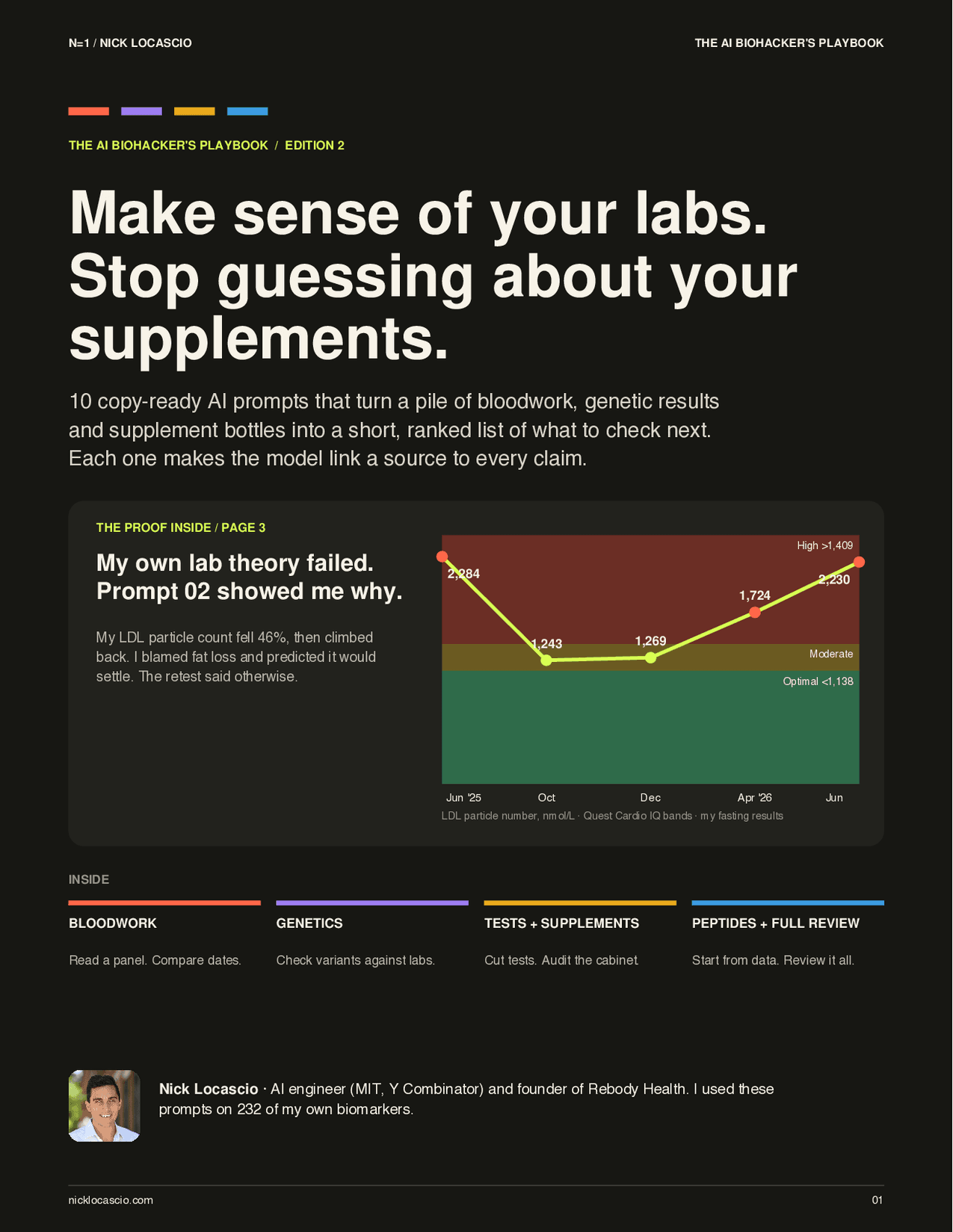
Here’s what you get.
- 01
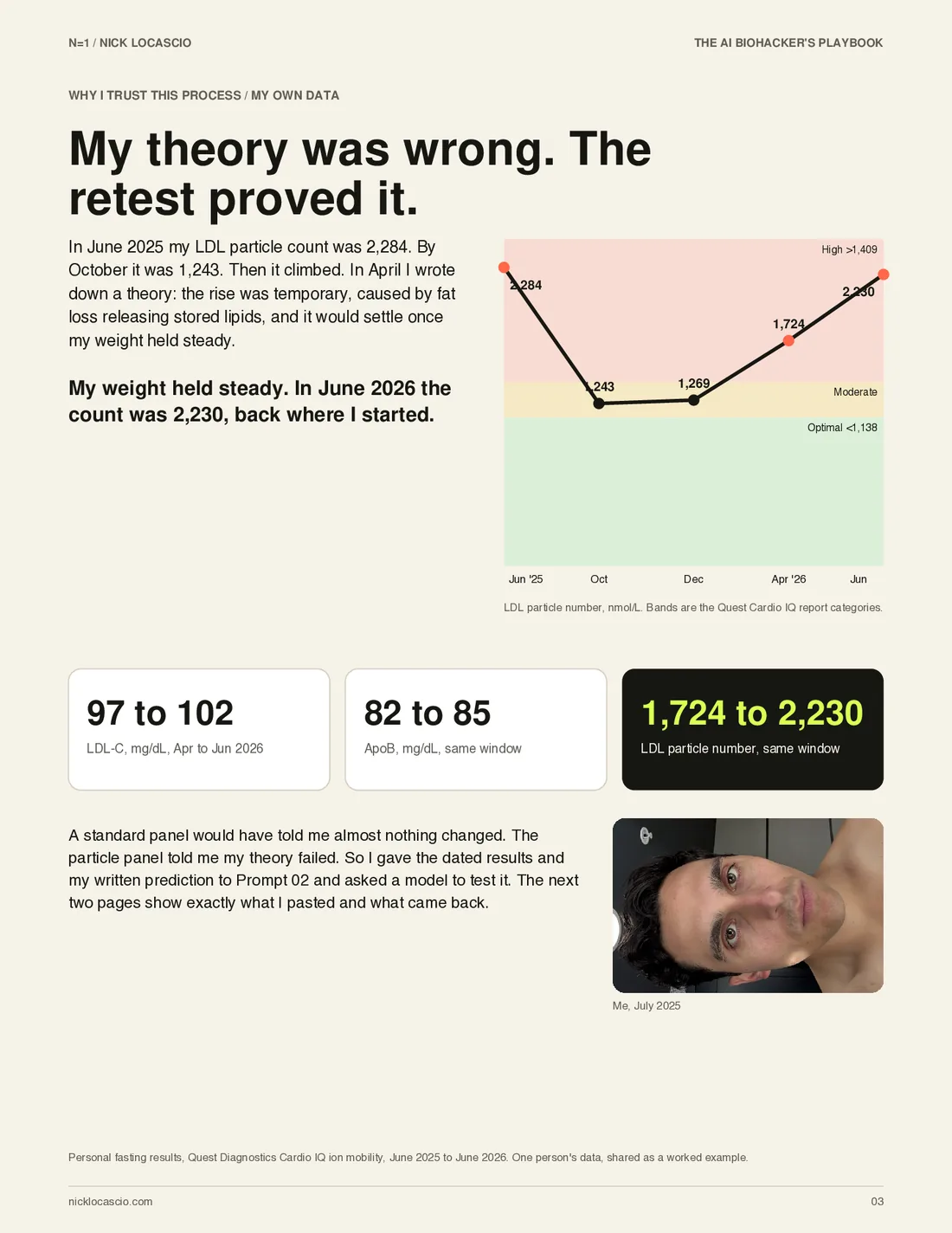
My theory was wrong
The LDL particle rebound that broke my own prediction, and why a standard panel would have missed it.
- 02
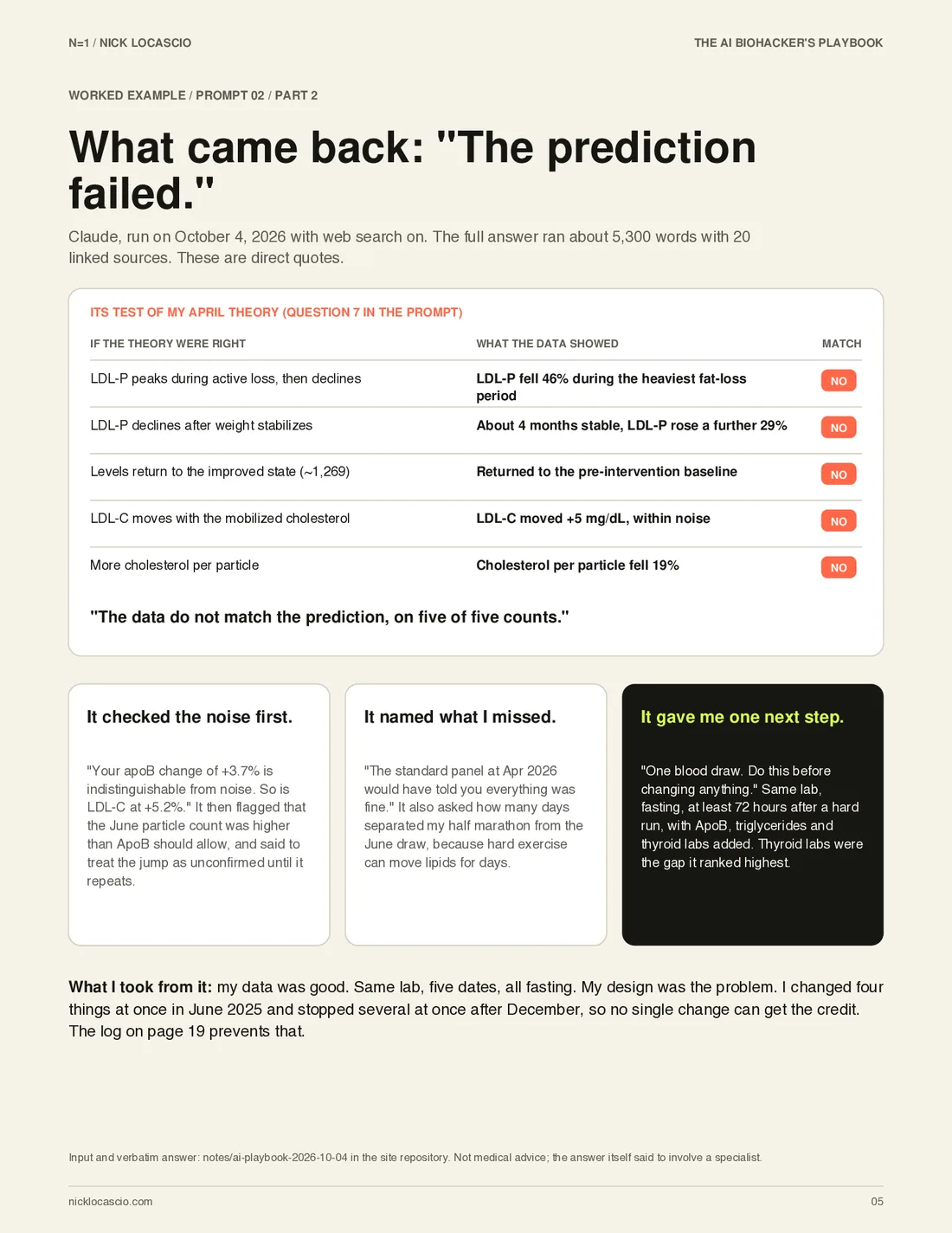
What came back
Prompt 02 tested my written prediction against five dated panels. It failed on all five counts.
- 03
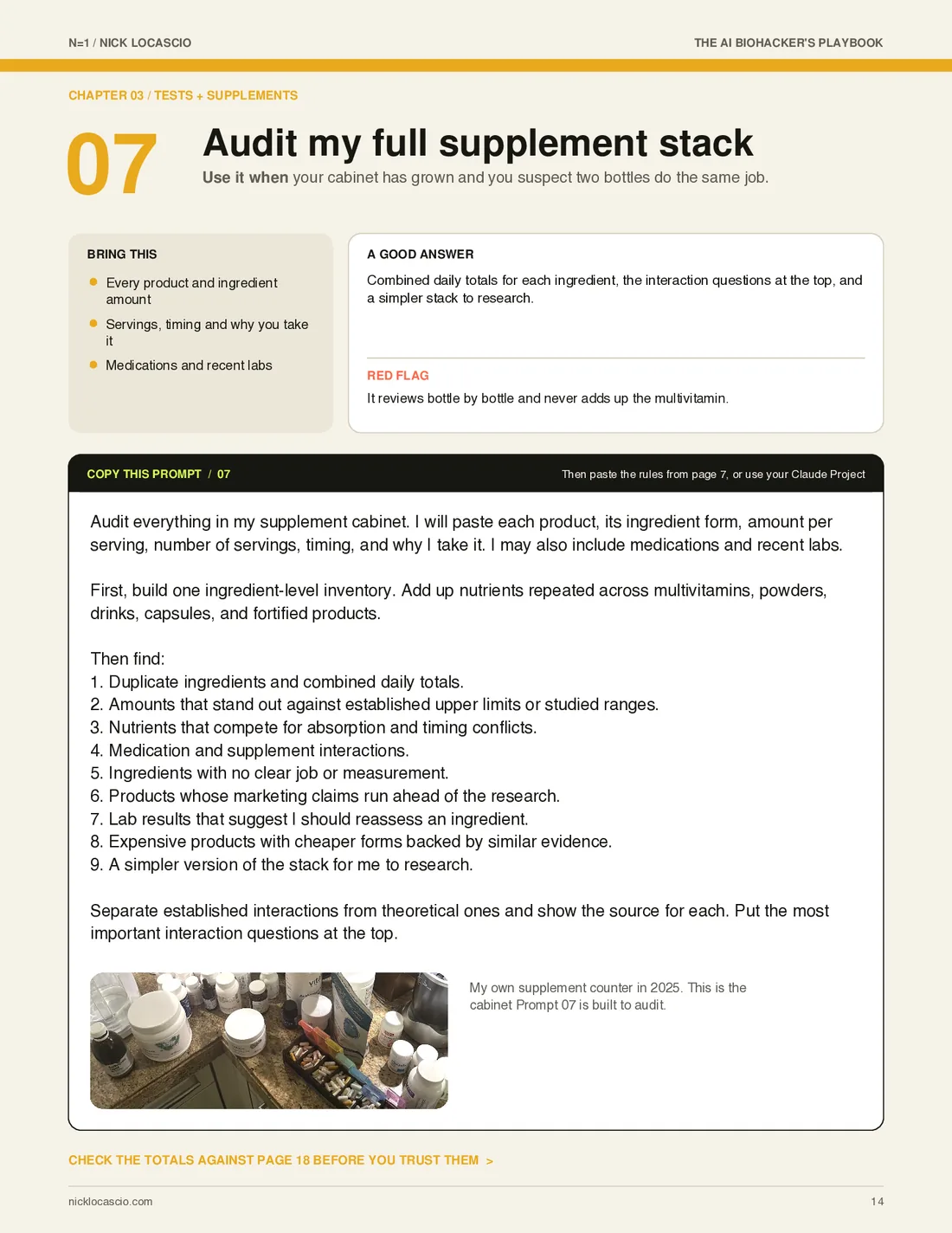
Audit my full supplement stack
When to use it, what to bring, what a good answer includes, and the red flag that means it skipped the math.
My own data
My lab theory failed. Prompt 02 showed me why.
My LDL particle count fell 46%, then climbed. In April I wrote down a theory: the rise came from fat loss and would settle once my weight held steady. My weight held. In June the count was back where I started.
A standard panel barely moved, so it would have told me nothing. I gave the dated results and my written prediction to Prompt 02. The guide shows exactly what I pasted and what came back.
LDL-P peaks during active fat loss, then declines
It fell 46% during the heaviest fat-loss period
NoLDL-P declines once weight stabilizes
Four months stable, it rose a further 29%
NoLevels return to the improved state
They returned to my pre-intervention baseline
NoLDL-C moves with the mobilized cholesterol
LDL-C moved 5 mg/dL, within noise
NoEach particle carries more cholesterol
Cholesterol per particle fell 19%
No“The data do not match the prediction, on five of five counts.”Claude's answer to Prompt 02, October 2026. It then said to retest once before changing anything, and named the labs to add.
Pick your question. Get the prompt that answers it.
Each prompt does one job. Start with Prompt 01 and your latest lab report if you are not sure.
Bloodwork
- 01You have one new lab report and want to know which results matter.
- 02You changed something and want to know whether it worked.
Genetics
- 03A report says a variant means you need something.
- 04You want to see which genetic claims show up in your blood.
Tests + supplements
- 05You want to cut the tests that will not change a decision.
- 06You are about to buy a supplement.
- 07You suspect two bottles in your cabinet do the same job.
Peptides + full review
- 08You want to start from your data, not a trend.
- 09You want every compound on a shortlist to earn one job.
- 10You have a pile of everything and want the next few questions.
Look inside first
Three real pages, before you give an email.
No sign-up to see these. They are unedited pages from the 20-page PDF, so you can judge the guide instead of a cover.
My theory was wrong
The LDL particle rebound that broke my own prediction, and why a standard panel would have missed it.
What came back
Prompt 02 tested my written prediction against five dated panels. It failed on all five counts.
Audit my full supplement stack
When to use it, what to bring, what a good answer includes, and the red flag that means it skipped the math.
Three steps. Your first answer in ten minutes.
- 01
Clean the packet
Remove your name. Keep the value, unit, printed range and date for every result. Date every change you made.
- 02
Paste one prompt
Add the seven rules underneath, or put them in a Claude Project once. Every prompt also comes as a plain-text file.
- 03
Check the answer
Open each source behind a decision. Confirm the paper exists, who was studied, what was given and what was measured.
The guide also includes the seven rules that make a model cite its sources, six red flags in an answer, and an experiment log with my own failed prediction as the first row.
The AI Biohacker's Playbook
Know which results deserve your attention first.
Bring your latest lab report and the list of what you take. Get a ranked answer with a source beside every claim.
Honest fit
Who this helps, and who should skip it.
Worth your time if
- You have lab reports across several dates and no way to see what moved.
- You want the model to cite sources rather than sound confident.
- You have a supplement cabinet you suspect is overlapping.
Skip it if
- You want the AI to diagnose you. Every prompt is built to stop it doing that.
- You are not willing to upload or paste your own results.
Before you download
The questions people actually ask.
Is it safe to put my lab results into an AI tool?
Uploading real reports to a hosted tool shares them with that provider. The playbook says so, and the prompts work fine on a single pasted panel with your name removed. Decide what to share before you start, not after.
Will the AI just make things up?
It can, which is why every prompt comes with seven rules that make the model link a source to each claim, label human versus animal evidence, and say when it cannot verify something. One page shows the four checks to run on any source before you act on it.
Do I need a paid Claude account?
No. The prompts are plain text and work in the free tier, and in ChatGPT and other tools. Longer panels go better with a larger context window.
Why is it free?
Because I want more people running careful experiments on themselves, and because some readers eventually become Rebody Health customers. That is the whole model. No upsell arrives with the guide.
What happens to my email address?
You get the guide, then AI Biohacking, which is what I am testing and measuring on myself. You also get the revised guide whenever the research changes. One click unsubscribes and the address is never sold or shared.
What you are getting
1,000+ people already have this guide.
- 10 copyable prompts
- Worked example on real lab data
- Plain-text prompt file
- Written for Claude, works elsewhere
- Last checked
- October 4, 2026. I rerun all ten prompts when the models change, and revise the guide when one stops behaving.
- When it changes
- The revised guide goes to everyone on the list. You do not have to come back for it.
- Who wrote it
- Nick Locascio. AI entrepreneur, founder of Rebody Health, co-founder of Booth AI (YC). My health experiments are personal experience, not medical advice. See the work behind it.
The rest of the field guides