Tissue repair
BPC-157 · Thymosin beta-4 · TB-500 fragment
Was healing measured in people, using this exact molecule?
YOUR GOAL / YOUR STARTING POINT
Find the peptides worth exploring for your health goals.
Recovery, fat loss, skin, sleep or focus: start with what you want to improve. Compare 21 compounds by the job they do, see the results behind them, and build a focused shortlist to discuss with your clinician.
PDF / 31 pages / selectable text / linked sources
Find the relevant compounds. See the results behind them.
01 / THE RESEARCH AREAS
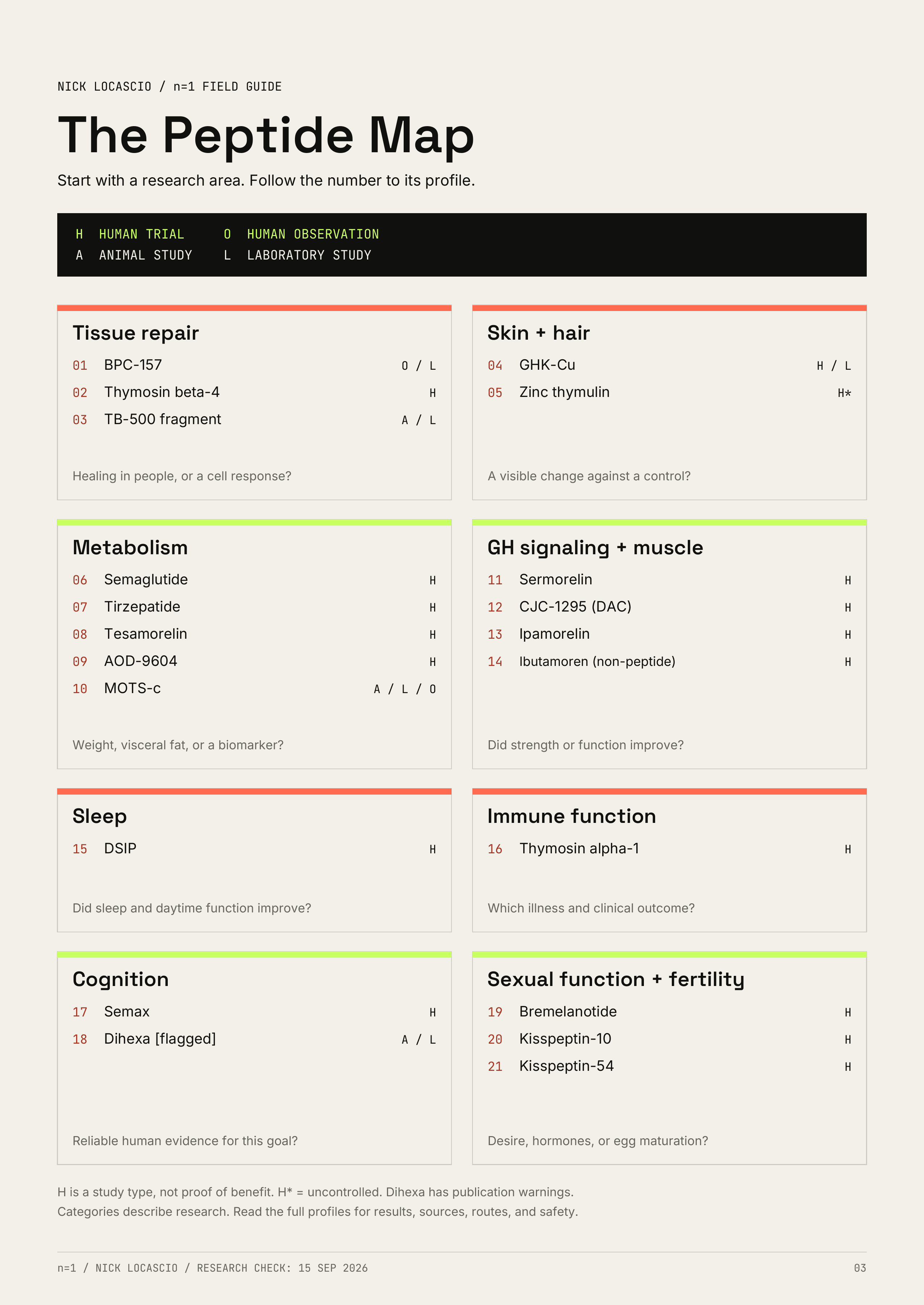
21 PROFILESChoose the area you want to improve, then compare the compounds and results in that section. Each numbered entry links the research to a specific goal.
BPC-157 · Thymosin beta-4 · TB-500 fragment
Was healing measured in people, using this exact molecule?
GHK-Cu · Zinc thymulin
Did a controlled study show a visible change?
Semaglutide · Tirzepatide · Tesamorelin · AOD-9604 · MOTS-c
Was the outcome weight, visceral fat, or a laboratory marker?
Sermorelin · CJC-1295 · Ipamorelin · Ibutamoren
Did strength or function improve when hormone levels changed?
DSIP
Did people sleep or feel better in a controlled trial?
Thymosin alpha-1
Which illness and clinical outcome were studied?
Semax · Dihexa
Are there reliable human results for the same problem?
Bremelanotide · Kisspeptin-10 · Kisspeptin-54
Was the target desire, hormone release, or egg maturation?
Ibutamoren is a non-peptide. Dihexa is peptide-derived, with publication warnings covered in its profile. The guide separates human findings from animal and laboratory results.
02 / KEEP THE REFERENCE
Find your goal, compare the relevant compounds, and save your shortlist. The one-page map helps you navigate; the profiles give you the results and questions to bring to your clinician.
A NOTE ON USE
This is an educational reference with selected primary research and official sources. It has not undergone independent clinical peer review. It includes questions to discuss with a clinician and contains no prescribing or administration instructions.