GHK-Cu: The Copper Peptide Field Guide
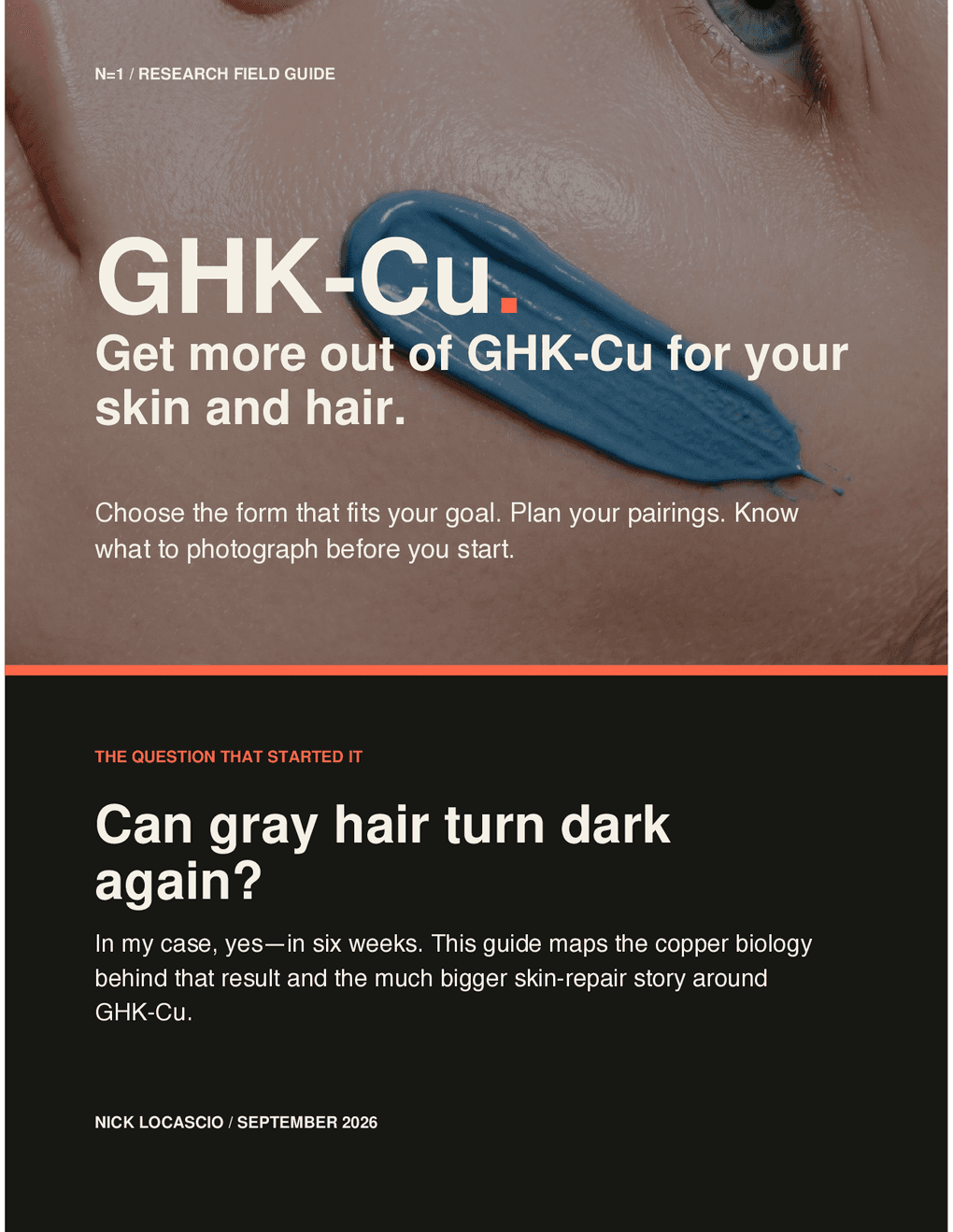
Get more out of GHK-Cu. For your skin and hair.
Drop your email and I’ll send you the guide.
Compare the forms, check the human evidence, and plan your pairings before you buy. Includes a 12-week photo plan.
Here’s what you get.
- 01
What to pair it with
Microneedling, retinoids, vitamin C, red light and minoxidil, each with the job it does and the timing that avoids a collision.
- 02
Which form fits your goal
Face cream, scalp solution, oral troche and injection, with the evidence behind each route. Percentages do not compare across routes.
- 03
The 12-week plan
Baseline, tolerance, signal, decision. Same camera, same light, no selective photo deletion.
THE RESULT
My gray hair turned dark again.
Two years ago, I started getting a shocking amount of gray pubic hair. I assumed it was age and stress. My bloodwork showed something else: I was copper deficient.
I started GHK-Cu. Around six weeks, there were fewer gray hairs. My repeat bloodwork moved from deficient to optimal.
That is one person who had a measured deficiency to correct, which is the weakest evidence there is. The guide keeps my result separate from the human studies, and page 12 covers the controlled trial that did not win.
Look inside first
Three real pages, before you give an email.
No sign-up to see these. They are unedited pages from the 22-page PDF, so you can judge the guide instead of a cover.
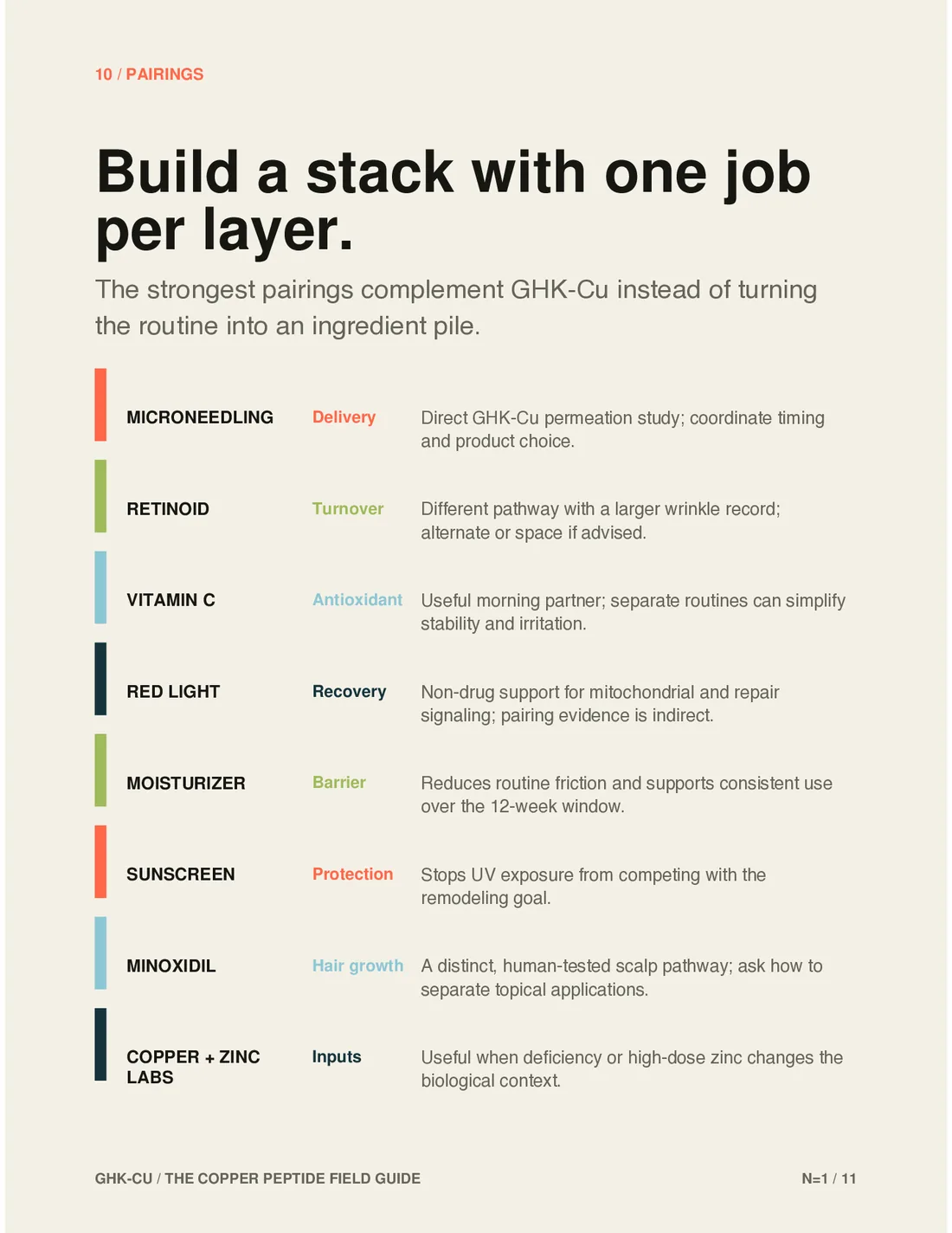
What to pair it with
Microneedling, retinoids, vitamin C, red light and minoxidil, each with the job it does and the timing that avoids a collision.
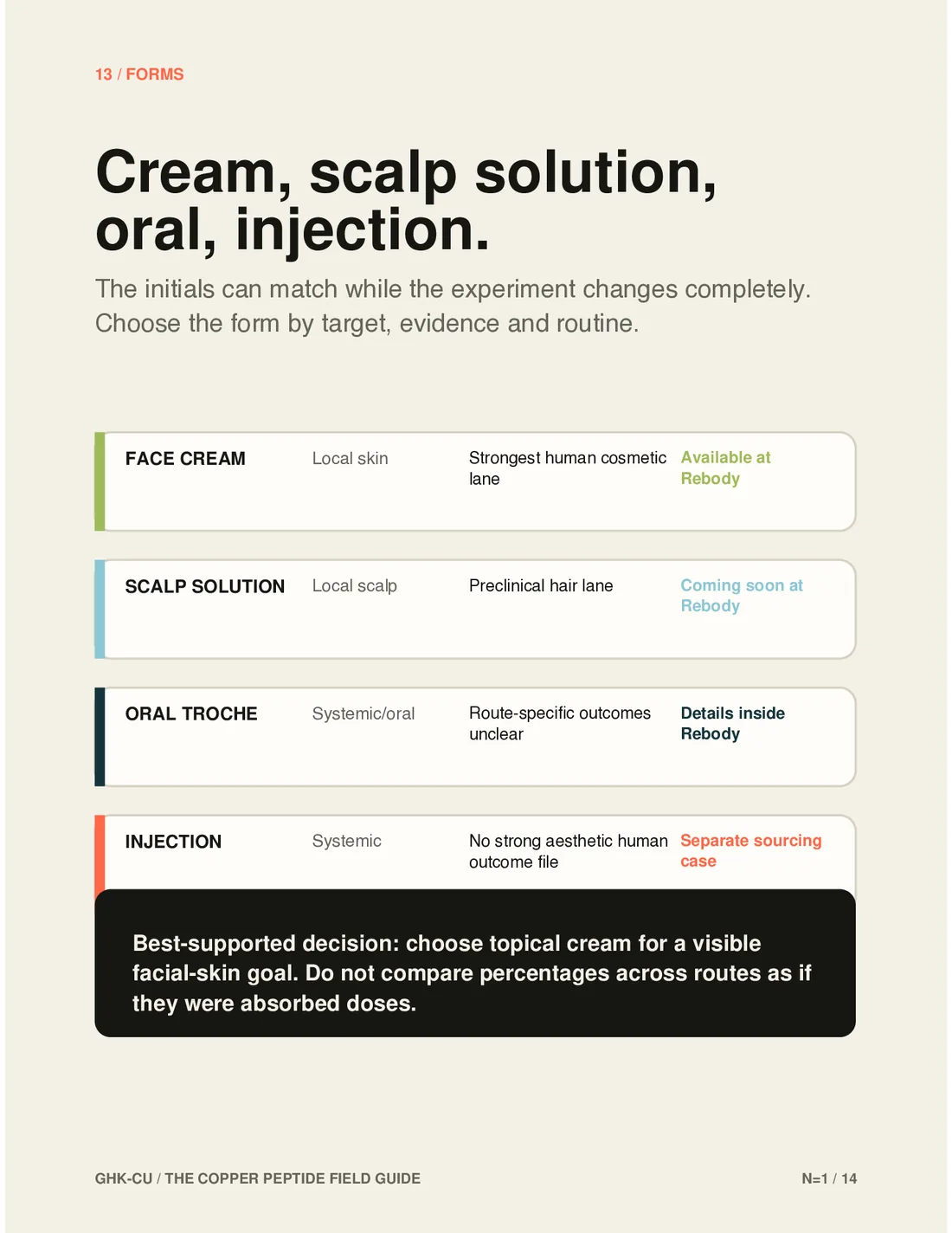
Which form fits your goal
Face cream, scalp solution, oral troche and injection, with the evidence behind each route. Percentages do not compare across routes.
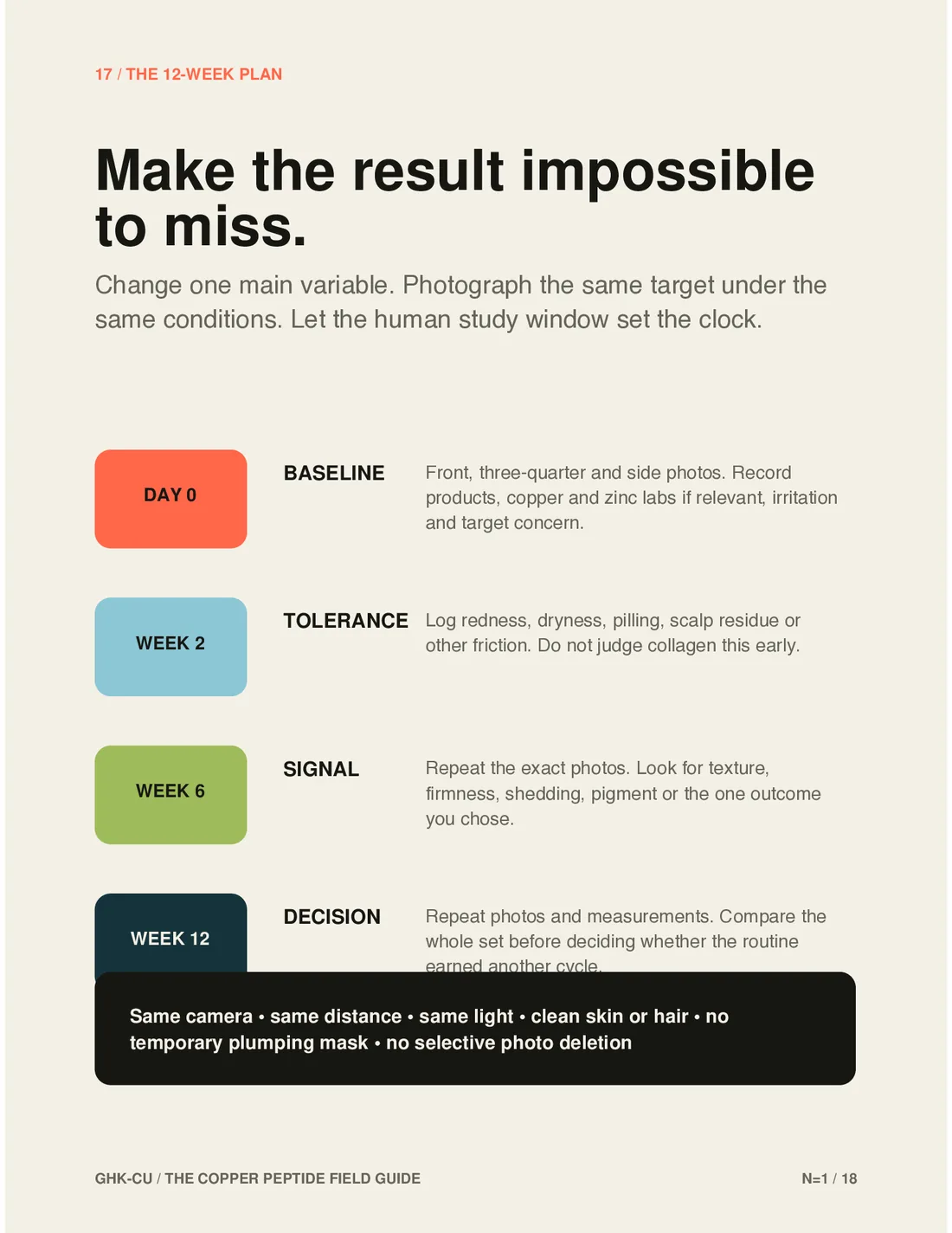
The 12-week plan
Baseline, tolerance, signal, decision. Same camera, same light, no selective photo deletion.
INSIDE THE GUIDE
22 PAGESThe useful map.
The guide connects mechanisms to the actual human, lab, animal, and N=1 results. Every paper and product source is linked inside the PDF.
- 01
Mechanisms + papers
Collagen, matrix remodeling, angiogenesis, antioxidant signaling, pigment biology, and the studies behind each lane.
- 02
The results map
Human skin outcomes, wound-repair findings, follicle research, microneedle delivery, and Nick's six-week result.
- 03
Pairings
Microneedling, retinoids, vitamin C, red light, moisturizer, sunscreen, minoxidil, and copper/zinc labs.
- 04
Creams + injections
What changes across face cream, scalp solution, oral formats, and injectable GHK-Cu.
- 05
Where to get it
A product-quality checklist and Nick's pick: Rebody Health GHK-Cu acetate 3% cream.
THE N=1 PROTOCOL
Make the change visible.
A useful experiment needs a baseline, one main variable, and the same measurement conditions each time.
- Set the baseline
- Choose one target
- Control the photo
- Keep a weekly log
- Review at 6 and 12 weeks
KEEP THE REFERENCE
Build a better
skin-and-hair routine.
Compare the forms, plan your pairings, and know what to photograph before you start.
22 pages. Linked sources. One practical protocol.
Honest fit
Who this helps, and who should skip it.
Worth your time if
- You are about to buy a copper peptide product and cannot tell the forms apart.
- You want to know whether the scalp and hair claims have human data behind them.
- You intend to photograph the change and want the conditions controlled.
Skip it if
- You want a dosing or injection protocol. The guide has neither.
- You want a single yes or no on whether GHK-Cu works for hair. The honest answer is on page 12, and it is not a yes.
Before you download
The questions people actually ask.
The guide recommends a Rebody product. Is that the point of it?
One page out of 22 names my pick, and it is a Rebody cream. I founded Rebody, so treat that page as an interest and not a review. The other 21 pages are the research, the forms comparison and the tracking plan, and they include a product checklist you can use to judge any brand, mine included.
Did your gray hair really turn dark again?
Fewer grays at around six weeks, and repeat bloodwork that moved from copper deficient to optimal. That is one person with a measured deficiency, which is the weakest kind of evidence there is. The guide says so on the page where the story appears, and page 12 covers the human study that did not win objectively.
Is 3% better than 1%?
Not in the way product pages imply. The forms page above explains why a percentage on a cream and a percentage on another route are not the same quantity, and what the human skin studies actually used.
Why is it free?
Because I want more people running careful experiments on themselves, and because some readers eventually become Rebody Health customers. That is the whole model. No upsell arrives with the guide.
What happens to my email address?
You get the guide, then AI Biohacking, which is what I am testing and measuring on myself. You also get the revised guide whenever the research changes. One click unsubscribes and the address is never sold or shared.
What you are getting
1,000+ people already have this guide.
- 22 pages
- Cream, scalp, oral and injection compared
- 12-week photo plan
- Linked primary sources
- Last checked
- October 4, 2026. I recheck the human studies and the U.S. status notes, and revise the guide when either moves.
- When it changes
- The revised guide goes to everyone on the list. You do not have to come back for it.
- Who wrote it
- Nick Locascio. AI entrepreneur, founder of Rebody Health, co-founder of Booth AI (YC). My health experiments are personal experience, not medical advice. See the work behind it.
The rest of the field guides
Every one is free, and built the same way.
This educational guide combines selected research with my personal experience. It contains no dosing, administration, or prescribing instructions.
Follow @nick.locascio