
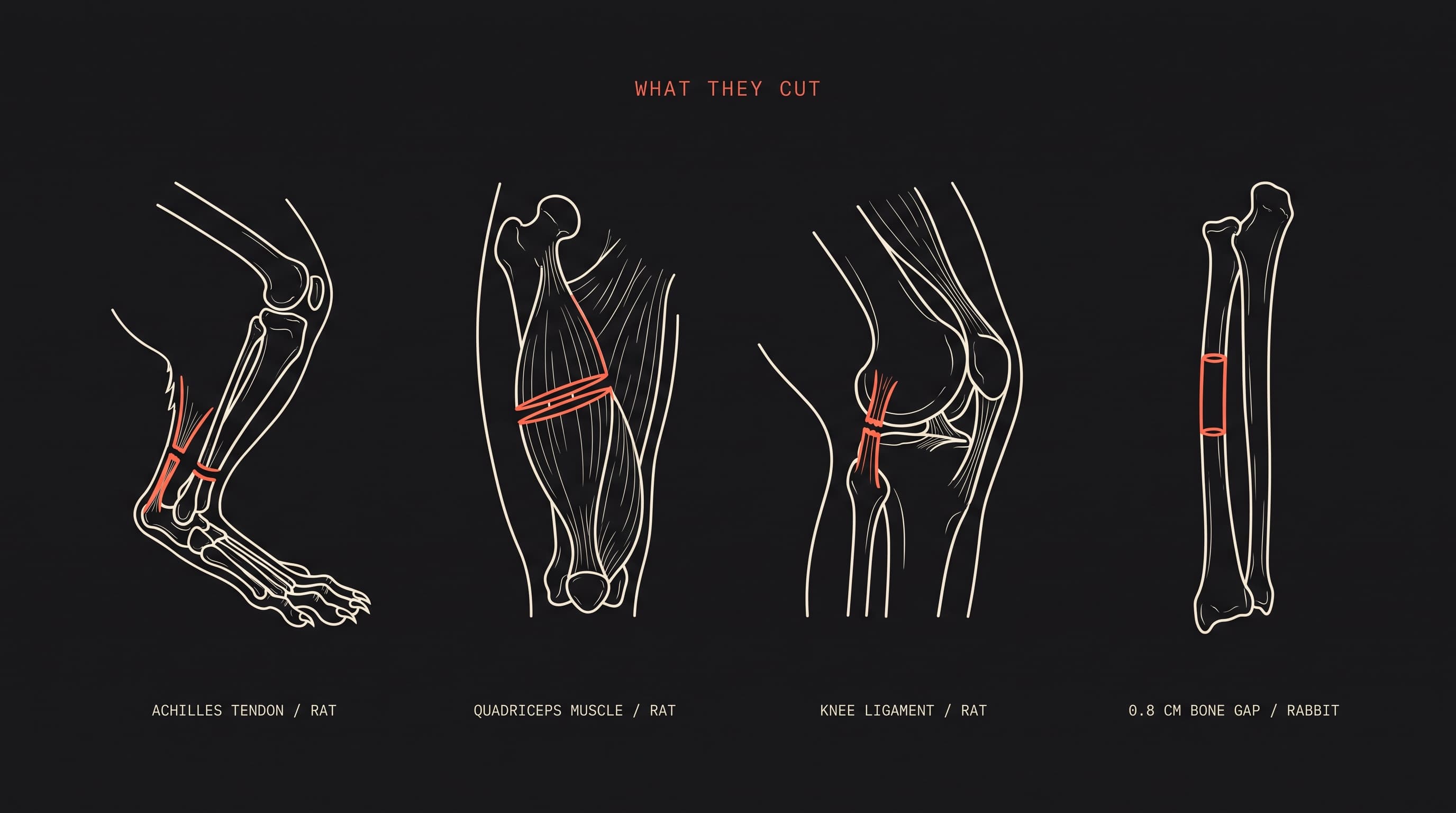
In 1999, a team cut a 0.8 centimeter segment out of a rabbit’s forearm bone and left the gap open.
Six weeks later, in every untreated rabbit, the gap was still a gap. That is what a segmental defect does: nothing. Bone that size does not come back. The rabbits that got BPC-157 filled it in, and the researchers compared the result to packing the hole with a bone graft.
That paper is 27 years old. Since then, BPC-157 has reattached severed Achilles tendons, rebuilt cut quadriceps muscle, healed knee ligaments when it was nothing more fancy than an ingredient in the drinking water, and closed a surgical hole between a rat’s colon and its bladder.
Now the number that should not go with that list.
The total count of humans who have taken BPC-157 inside a published study is about 30.
Not 30,000. Thirty. For the peptide your gym friend won’t shut up about, the one people call the Wolverine compound, the one I take.
That gap is the whole story of BPC-157, and the reason for it is not the one you are expecting. Nothing failed. The trial that would have settled it never got run.
A Peptide Fished Out of Stomach Juice
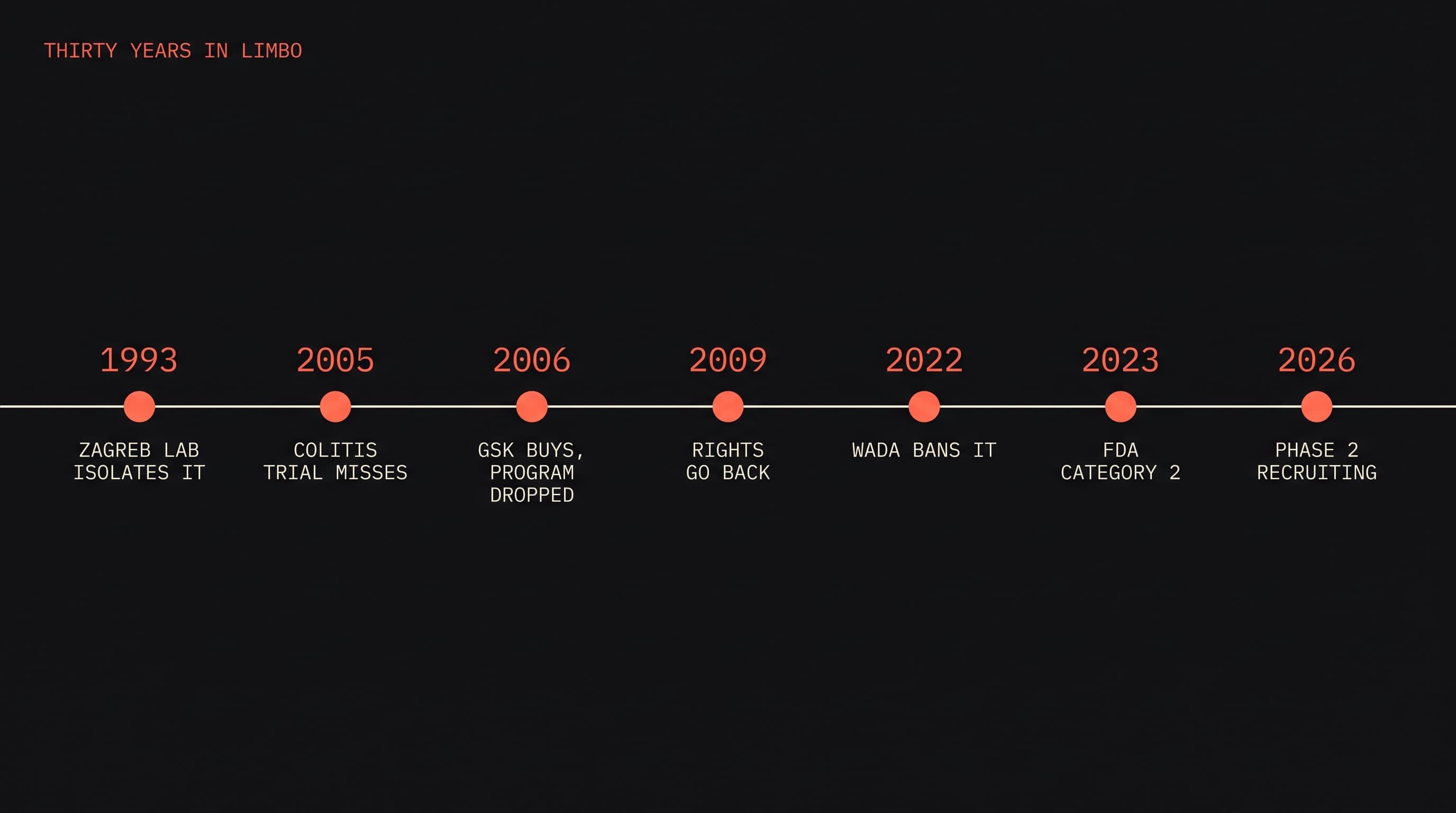
In 1993, a team at the University of Zagreb published a peptide they pulled out of human gastric juice. They had found a large protein, about 40,000 daltons, that seemed to protect tissue. They called it BPC, for Body Protection Compound, and then reported a 15-amino-acid fragment of it that they believed carried the activity.
That fragment is BPC-157: GEPPPGKPADDAGLV. Fifteen amino acids. That’s it. For comparison, insulin has 51.
The pitch that made it famous is right there in the origin story. This thing supposedly comes from your stomach, which is a blender of acid and enzymes, so it survives conditions that destroy most peptides. A 1995 report said it resisted hydrolysis in gastric juice. That’s the basis for every “you can just take it orally” claim you have ever read.
Hold that thought, because it comes back later in a way I did not expect.
What It Does in Rats (A Lot)
This is where BPC-157 earns the hype, and I am not going to soften it, because the animal results are genuinely wild.
It reattached severed Achilles tendons. In a 2003 study, researchers cut rat Achilles tendons clean through, 5 mm above the heel. Treated rats got BPC-157 by injection once a day for two weeks. The treated tendons ended up stronger under load, stiffer in the right way, with better collagen and fibroblast organization, and the rats walked better. The paper describes reestablishment of full tendon integrity.
It healed cut quadriceps muscle. Same group, 2006, transected rat quad muscle, 72 days of follow-up. Better load to failure, better walking recovery, and real muscle regeneration instead of the contracture the controls got.
It worked when they put it in the drinking water. In a 2010 knee-ligament study, rats had their medial collateral ligament cut. BPC-157 helped by injection, as a topical cream, and dissolved in drinking water at 0.16 micrograms per milliliter. Same healing, three delivery routes.
It fixed bone that does not fix itself. That is the rabbit study from the top. Worth adding: the rabbits healed whether the peptide went straight into the defect or into a muscle somewhere else entirely, and one group got it only intermittently. The bone did not need it delivered to the address.
It closed a hole between a rat’s colon and its bladder. In 2016, rats had a surgical fistula created between the two. BPC-157, given orally in drinking water or by injection, closed both defects.
That last one is the study that tells you why people take this for their gut.
How It Might Work, In a Nutshell
Damaged tissue cannot rebuild without blood supply. Nutrients, oxygen and repair cells all arrive through vessels, and if the vessels do not show up, the repair stalls. Most of what BPC-157 appears to do sits in that one job: getting the plumbing built.
In 2017, a team showed BPC-157 increased vessel density and tube formation, sped up blood-flow recovery in a rat limb-ischemia model, and did it by up-regulating VEGFR2, the receptor cells use to hear the “build vessels” signal. It did not raise the signal itself. It raised the number of ears.
A 2011 study found BPC-157 increased FAK and paxillin phosphorylation in tendon cells, which is how cells grip and crawl, and the cells migrated more and survived oxidative stress better. A 2014 study found the growth hormone receptor among the most up-regulated genes in those same tendon cells.
And in January of this year, a group traced a route inside the cell: BPC-157 binds a protein called FBXO22 using the proline at position three, which blocks FBXO22 from tagging BACH1 for destruction. More BACH1 survives, and those vessel-lining cells multiply and form tubes.
So the story is coherent: a repair-crew dispatcher. It does not build anything itself. It makes the build order louder.
Coherent is not the same as proven, which brings us to the part nobody posts about.
So Why Has Nobody Run the Trial?
This is the part that gets left out of every BPC-157 thread, and it is the reason the human studies are so small.
A Croatian pharmaceutical company, PLIVA, took BPC-157 into humans as PL 14736 for ulcerative colitis. In a 2005 randomized trial in 53 patients, the treated group’s disease score fell twice as far as placebo. The difference between groups did not reach statistical significance, in a two-week study of an enema, with 53 people. In 2006, GSK bought PLIVA’s research institute and dropped the program. Rights went back to the original researcher in 2009. A phase 1 oral tablet trial registered in 2015 still shows a status of unknown, with no posted results.
So it never failed in a way that killed it. It just fell through the floor of corporate reorganization and never got picked back up by anyone with real money.
Meanwhile, the gray market discovered it.
- WADA banned it in 2022, under S0, the category for substances not approved for human use anywhere. No therapeutic exemption is possible.
- The FDA put it in Category 2 in September 2023, the list of bulk drug substances that may present significant safety risks for compounding. The agency’s stated reasons: immunogenicity risk for some routes, impurity and characterization problems, and not enough safety information.
- In July 2026, an FDA advisory committee voted 8 to 6 in its favor for ulcerative colitis, against FDA staff’s own recommendation. The vote is non-binding, and there is no final decision.
Which leaves BPC-157 exactly where it has been for a decade: too interesting to ignore, too unstudied to approve, and available to anyone with a browser.
Every Human Who Has Taken It In a Study
So the human file is thin. Here is the entire thing, and the interesting part is not how small it is. It is that nothing in it has gone wrong.
| Study | Who | How many | What happened |
|---|---|---|---|
| 2002-03 phase 1 (abstracts only) | Healthy adults, enema | 32 randomized | Tolerated. BPC-157 was not detected in the blood at all. |
| 2005 ulcerative colitis RCT (abstract only) | Mild-to-moderate UC, 80 mg enema, 2 weeks | 53 randomized | Disease score dropped more than placebo, but the difference was not statistically significant. |
| 2021 knee chart review | Knee pain, injected into the joint | 16 patients | 87.5% reported improvement. No validated outcome measures, no control group. |
| 2024 interstitial cystitis pilot | Women who had failed standard therapy | 12 women | 10 of 12 rated their result 100% after one procedure. |
| 2025 IV safety pilot | Adults already using IV BPC-157 | 2 people | 10 mg then 20 mg. No changes in heart, liver, kidney, thyroid or glucose markers. |
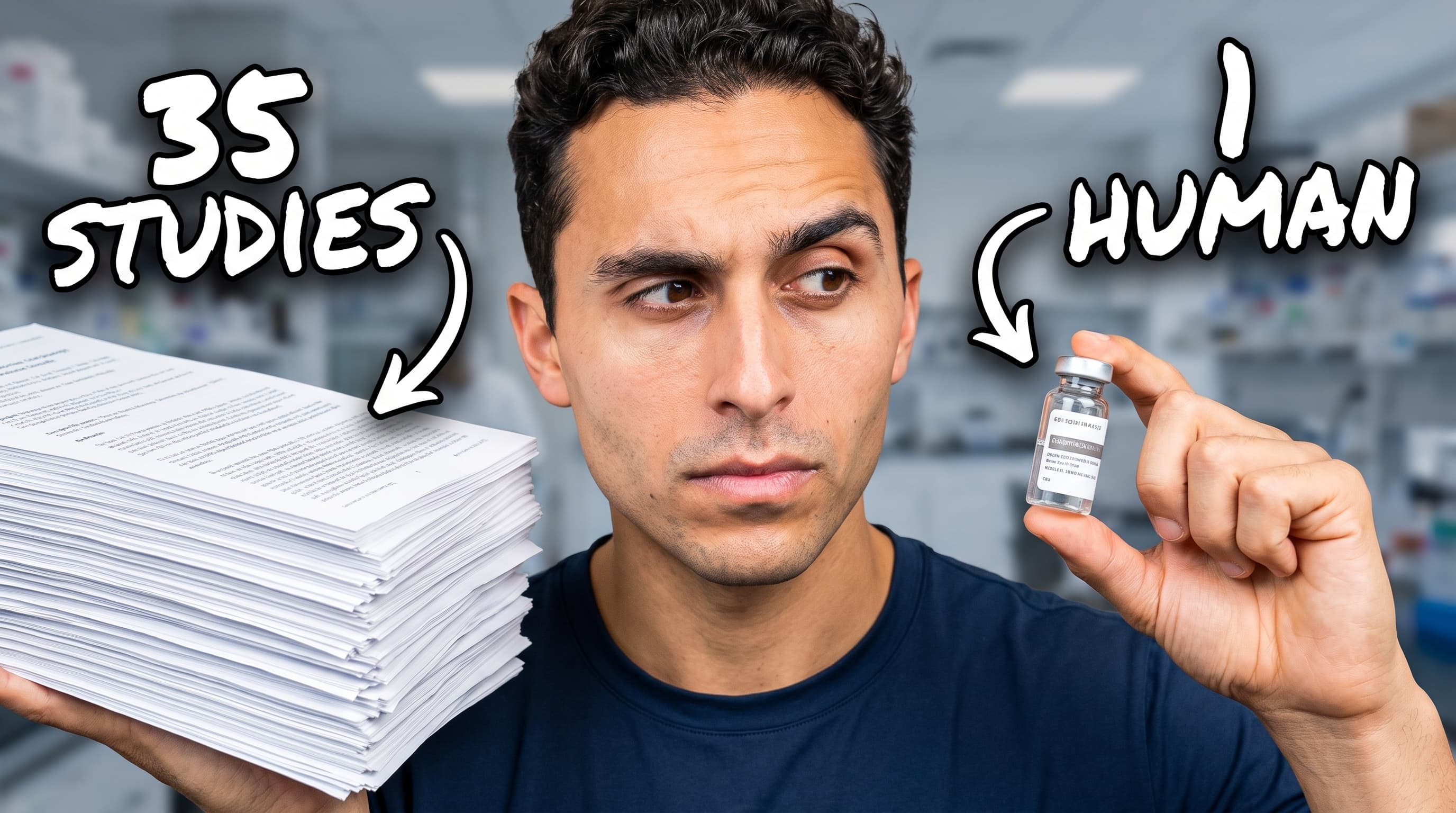
A 2025 systematic review screened 544 BPC-157 articles published between 1993 and 2024 and included 36. Thirty-five were preclinical. One was clinical.
Ten of twelve women with interstitial cystitis, all of whom had already failed the standard drug, rated their result 100% after a single procedure. Nearly nine in ten knee patients improved. Nobody got hurt. Those are uncontrolled studies run by one clinic, and they are the kind of early signal that normally gets a drug company on a plane.
Instead the file just sits there, which tells you something about funding, not about the molecule.
The Twist That Made Me Sit Up
Two things stand out once you read the studies themselves rather than the summaries of them.
First, this is basically one lab’s molecule. A 2025 analysis counted more than 190 papers on BPC-157, and more than 80% list the same two Zagreb researchers as first or senior author. Independent labs have contributed a handful of cell studies and short rodent experiments. The lead researcher also holds the patent on isolating the parent protein.
Plenty of great science starts in one lab. It is still unusual for a compound this popular to have almost no independent replication after 30 years.
Second, and this one is genuinely strange: nobody can find the parent protein. BPC-157 is supposed to be a fragment of a protein in human gastric juice. Chemists who have gone looking say that sequence does not appear in the human genome, and a 2025 analysis notes it shows no sequence homology with known intestinal peptides. One researcher has suggested the original team may have misread an amino acid sequence decades ago. The Zagreb group rejects this.
Sit with that for a second. The most popular “natural healing peptide” on the internet may not be a human peptide at all. Its own origin story is an open question, and it still healed those rabbit bones.
Nobody Has Been Able to Kill a Rat With It
The safety file is better than the hype cycle deserves.
In animals, nobody has found a lethal dose. A 2020 toxicity study in mice, rats, rabbits and dogs found no single-dose toxicity and good tolerance on repeat dosing, and the FDA later derived no-effect levels of 20 mg/kg in rats and 10 mg/kg in dogs. To be precise, “no lethal dose found” means at the doses they tested. It is still a striking result.
In humans, the FDA searched its adverse event database through December 2025 and found three reports, all from injections. One was injection-site swelling. One was shortness of breath that sent someone to the ER. The third is the one I remember: a woman on BPC-157 and TB-500 developed diffuse skin darkening and darkened gums, which came back when she took it again. The FDA’s read is that the drug likely caused it.
Three reports is not an epidemic. It is also not the “zero adverse events ever recorded” you see repeated online, and compounders mostly do not report to that database anyway, so the true number is higher than three.
The theoretical worry is the flip side of the mechanism. A compound whose main trick is building blood vessels is a compound you think twice about if something in you is already growing that you would rather starve. There is no human evidence that BPC-157 causes or accelerates cancer. There is also no carcinogenicity study, and no long-term human data of any kind.
What I Did With It
I put BPC-157 first in this series because of a blood test of my own.
In June 2025, I ran a food allergy panel at Infinite Allergy Labs. Egg white IgE came back above 100, which is the top of the scale, with complement activation detected on top of it. Egg yolk 24. Gluten 7.25. Walnut 6.36. Beef, beans, goat milk, tomato, hazelnut, peanut, cashew, lamb, all elevated. I was reacting after meals with blotchy rashes across my stomach and ribs, and I had rosacea on my face.
Cutting foods out did not fix it. It just made the list longer.
In October 2025, I started a gut protocol built around the barrier itself: BPC-157 at 500 micrograms twice a day, an HMO prebiotic, Bifidobacterium, and antimicrobials for a staph overgrowth sitting at the 99.9th percentile. In January 2026 I added thymosin alpha-1, which is Day 29 of this series.
In May 2026, I retested at the same lab.
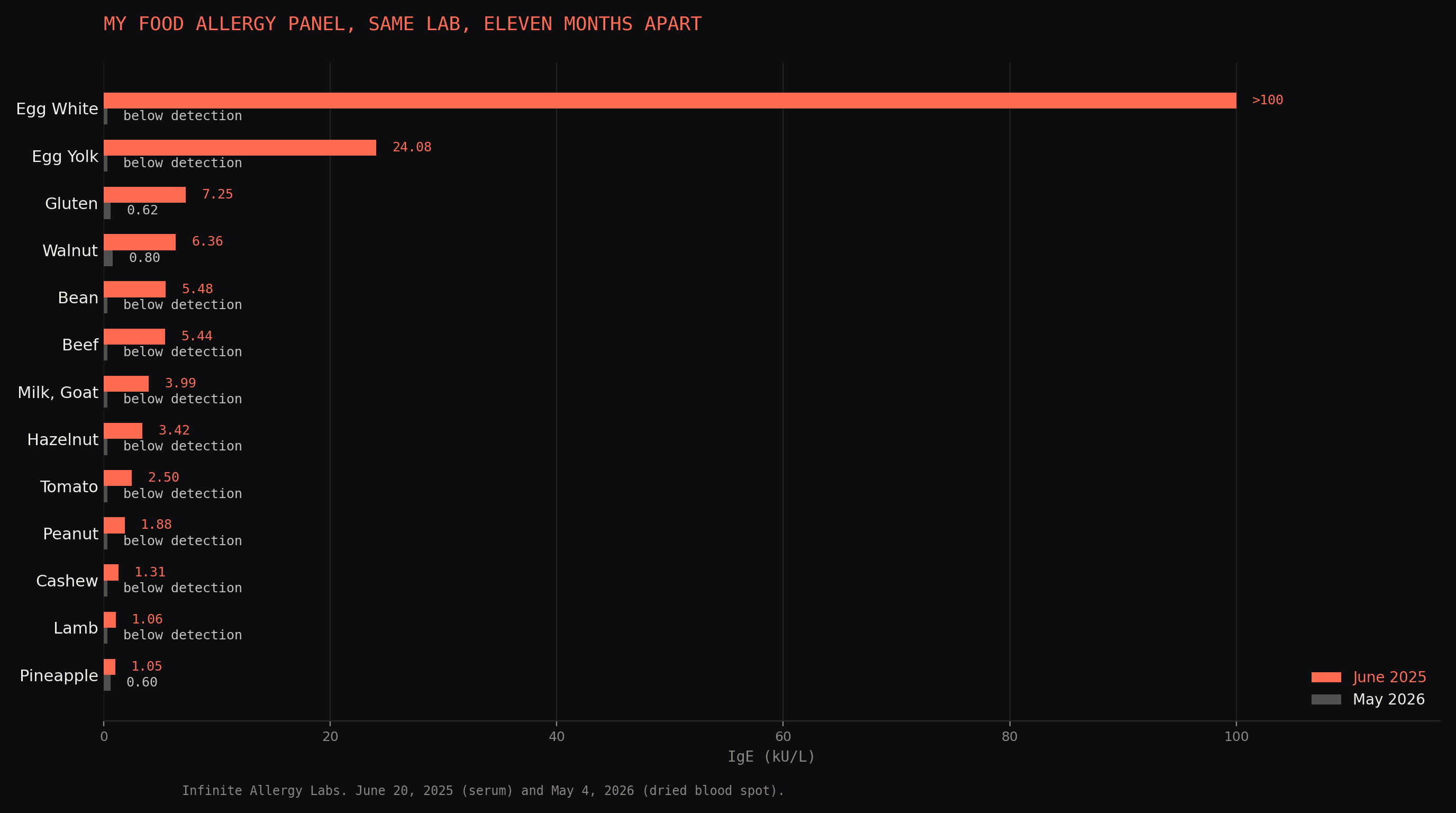
Eleven resolved, three improved. The egg white complement activation went from detected to not detected. I eat steak now with nothing happening.
Was that BPC-157? It was BPC-157’s job. It was the barrier-repair piece of a protocol that also rebuilt my Bifidobacterium from the 15th percentile to the 75th, knocked down a staph overgrowth, and later added an immune-modulating peptide. I would not hand any single item on that list the whole result. I also would not have built the protocol without the repair signal in it, and I still take it today, now as an oral combination with KPV.
That is my honest read of my own data, and it is exactly the kind of evidence this series exists to keep in its place: it is an n of 1, it is uncontrolled, and it happens to be mine.
If You Are Going to Take It Anyway
Most people reading this have already made their decision, so here is the part that actually matters.
The molecule is the easy problem. The vial is the hard one. Nothing in the research file above tells you what is in the bottle you just bought. The research-use-only market runs on shifting supply chains behind shell companies, certificates of analysis that are sometimes stale and sometimes fabricated, and resellers who get shut down and reopen under a new name. Order twice from the same site a week apart and you can get product from two different sources.
Four things I want to know before anything goes in my body:
- Is the right molecule in there? A real certificate of analysis, matched to the actual batch, with mass spectrometry showing molecular weight.
- Is anything else in there? The same panel should screen for lead, aluminium and fentanyl. Those are not theoretical.
- Was it made somewhere sterile? A vial compounded in a real facility, not grown quietly in someone’s back room.
- Is a clinician involved in the dose? Not for permission. For the part where somebody who has seen a thousand of these tells you the number.
I used to inject research-market peptides with my eyes closed and hope. That fear is the reason I started a company that does this through a licensed pharmacy with batch testing and a clinician attached, because I wanted the version I could not buy.
Tested In Whom, For What?
BPC-157 regrows severed tendons, fills bone gaps that otherwise stay open, and closes surgical holes between organs. In rats. Thirty years of it, across five tissue types, with no lethal dose ever found.
In humans, it has been given inside a study to about 30 people, and every one of those studies came back positive or neutral. Nobody ran the big one, because the company that owned it got sold.
Every peptide in this series gets filed in one of four rows, by how well its evidence matches the claims made for it: proven in humans, direct match, species gap, or different question. BPC-157 goes in species gap, which is where honest people have to put it today. What it is not is disproven. There is a difference between “we tested it and it failed” and “we never tested it,” and BPC-157 is squarely the second.
Here is the part I am actually excited about: that is finally changing. A phase 2 trial in hamstring injuries, 120 patients, daily injections for two weeks, is recruiting right now. A rotator cuff pilot is queued behind it. In July, an FDA advisory panel looked at the same evidence I just walked you through and voted in its favor anyway.
Thirty years after a Croatian lab pulled it out of stomach juice, BPC-157 is about to get the trial it should have had in 2006. I plan to be watching.
Day 2 is the opposite problem: a peptide tested in tens of thousands of humans, over years, with hard outcomes like heart attacks counted. Semaglutide.
References
- Sikiric, P. et al. “A new gastric juice peptide, BPC. An overview of the stomach-stress-organoprotection hypothesis and beneficial effects of BPC.” Journal of Physiology (Paris), 87(5):313–27 (1993).
- Staresinic, M. et al. “Gastric pentadecapeptide BPC 157 accelerates healing of transected rat Achilles tendon and in vitro stimulates tendocytes growth.” Journal of Orthopaedic Research, 21(6):976–83 (2003).
- Staresinic, M. et al. “Gastric pentadecapeptide BPC 157 counteracts the transected quadriceps muscle.” Journal of Orthopaedic Research, 24(5):1109–17 (2006).
- Cerovecki, T. et al. “Pentadecapeptide BPC 157 (PL 14736) improves ligament healing in the rat.” Journal of Orthopaedic Research, 28(9):1155–61 (2010).
- Sebecic, B. et al. “Osteogenic effect of a gastric pentadecapeptide, BPC-157, on the healing of segmental bone defect in rabbits.” Bone, 24(3):195–202 (1999).
- Grgic, T. et al. “Stable gastric pentadecapeptide BPC 157 heals rat colovesical fistula.” European Journal of Pharmacology, 780:1–7 (2016).
- Hsieh, M.-J. et al. “Therapeutic potential of pro-angiogenic BPC157 is associated with VEGFR2 activation and up-regulation.” Journal of Molecular Medicine, 95(3):323–33 (2017).
- Chang, C.-H. et al. “The promoting effect of pentadecapeptide BPC 157 on tendon healing involves tendon outgrowth, cell survival, and cell migration.” Journal of Applied Physiology, 110(3):774–80 (2011).
- Chang, C.-H. et al. “Pentadecapeptide BPC 157 enhances the growth hormone receptor expression in tendon fibroblasts.” Molecules, 19(11):19066–77 (2014).
- Zhang, J. et al. “BPC157 binds FBXO22 to stabilize BACH1 and promote endothelial proliferation.” Cell Communication and Signaling, 24(1):149 (2026).
- Lee, E. & Padgett, B. “Intra-articular injection of BPC 157 for multiple types of knee pain.” Alternative Therapies in Health and Medicine, 27(4):8–13 (2021).
- Lee, E., Walker, C. & Ayadi, B. “BPC 157 for interstitial cystitis: a pilot study.” Alternative Therapies in Health and Medicine, 30(10):12–17 (2024).
- Lee, E. & Burgess, S. “Intravenous BPC 157: a safety pilot.” Alternative Therapies in Health and Medicine, 31(5):20–24 (2025).
- Vasireddi, N. et al. “Emerging use of BPC-157 in orthopaedic sports medicine: a systematic review.” HSS Journal, 21(4):485–95 (2025).
- Xu, C. et al. “Preclinical safety evaluation of body protective compound-157.” Regulatory Toxicology and Pharmacology, 114:104665 (2020).
- U.S. Food and Drug Administration. Briefing document, Pharmacy Compounding Advisory Committee, BPC-157 (July 2026).