In June 2025 I got my bloodwork back and my morning cortisol was 0.49. The bottom of the normal range is 1.5.
That explained a lot. I could sleep fourteen hours and wake up like I hadn’t slept at all. I didn’t want to become a biohacker. I wanted enough energy to work and live normally.
So every day I started standing in front of a wall of red LEDs, looking like a rotisserie chicken. By October my morning cortisol was 3.9. Eight times higher, and right back inside the range.
People assume the panel is a skincare thing. Skin is my third reason. The first is that my body had stopped knowing what time it was. The second is that I want 20/20 vision for the rest of my life.
All three come down to one idea. Light does two jobs in your body. It’s information: your eyes read it, and your brain uses it to set the clock that runs your hormones. And it’s energy: certain wavelengths get absorbed by your mitochondria, the part of each cell that makes power. Reason one is the information. Reasons two and three are the energy.
My Body Had Stopped Knowing What Time It Was
Cortisol gets called the stress hormone, but it’s also your wake-up signal. In a healthy person it peaks around 7 or 8 a.m., right as you wake, then falls all day and bottoms out around midnight. That morning spike is a big part of what gets you out of bed.
Mine had no spike. At 0.49 I wasn’t just low, I was under the floor. Getting out of bed felt impossible, and now I had a number that said why.
Red light talks to the clock
Your master clock sits in the hypothalamus, and its main input is light hitting your eyes. It uses that signal to time sleep, body temperature and hormone release, cortisol included.
Most circadian advice is about blue light, because blue shifts the clock hard and crushes melatonin. That’s why you’re told to put your phone away at night. Red light was supposed to be invisible to the clock.
It isn’t. In a 2014 study in Singapore, researchers kept 24 young men in windowless suites for six days. One group got six hours of continuous 631 nm red light near their biological night. Their cortisol rhythm moved by about an hour and a half, and their melatonin wasn’t significantly suppressed. Red light reaches the cortisol clock without the melatonin penalty you get from blue.
Six hours in a lab at night is a very different dose from fifteen minutes in front of a panel. But the channel is real, and I had a flat curve to fix.
Ninety days, then the retest
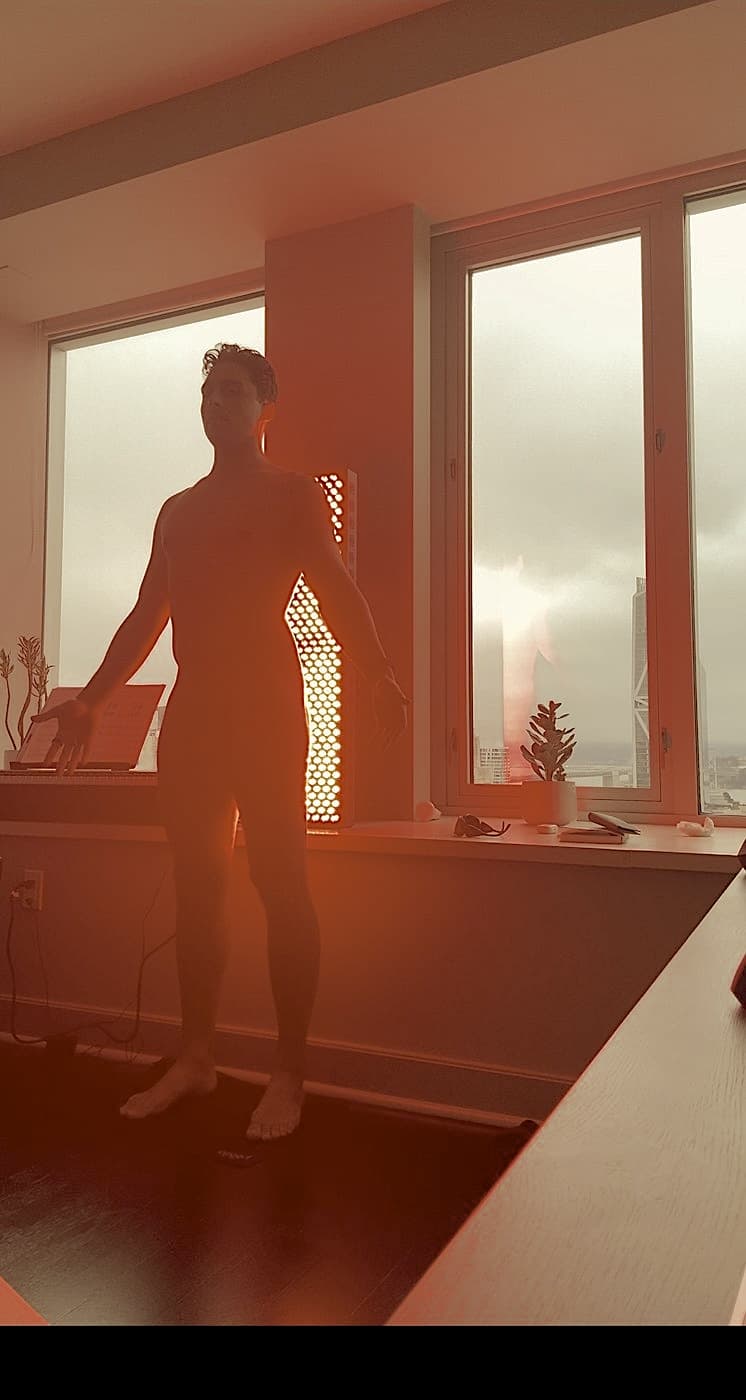
I stood in front of the panel every day for 90 days. Then I retested.
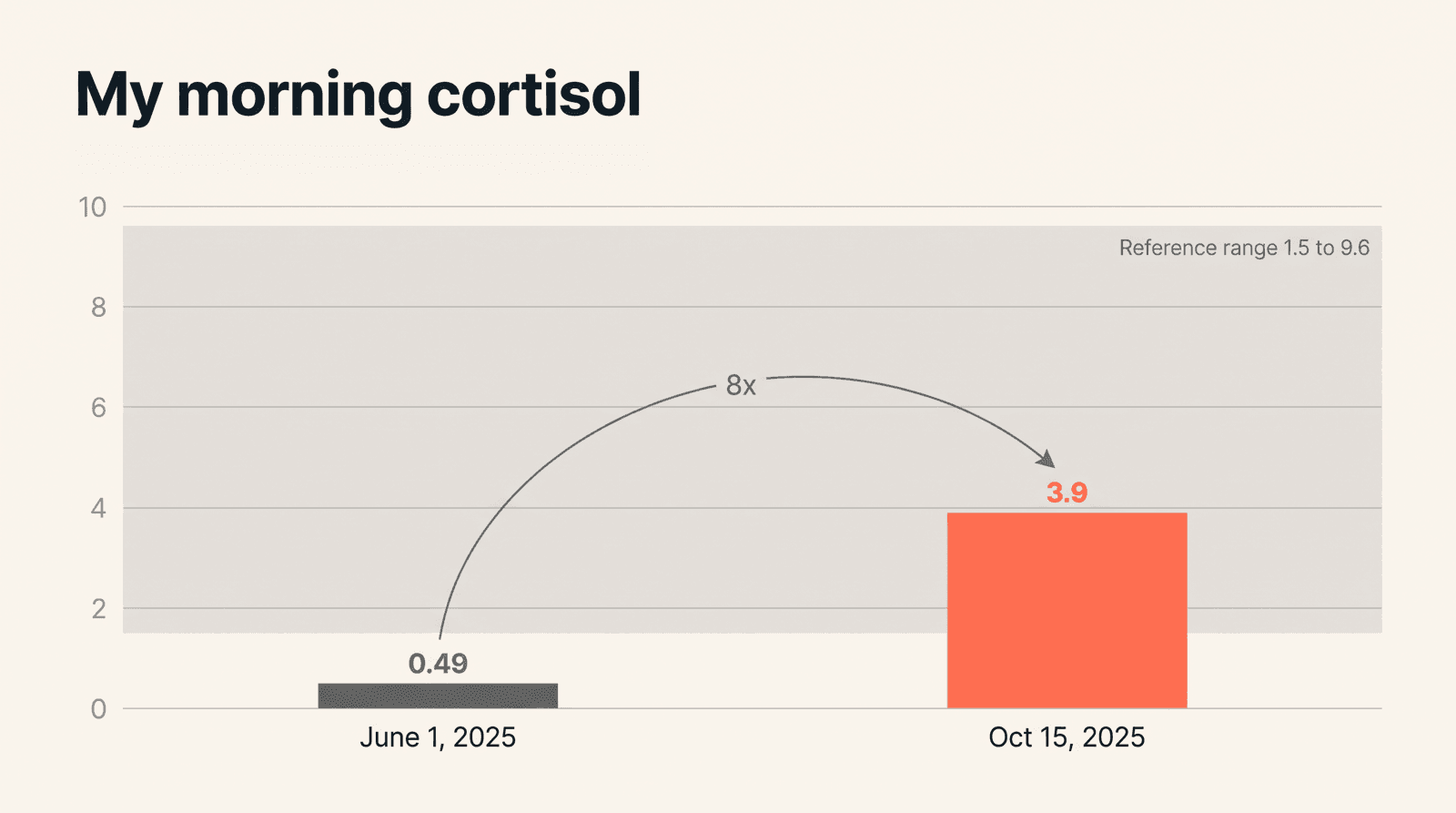
3.9. I was thrilled. It was the first time in that whole stretch that a lab said the thing I was doing every day was working, not just that something was wrong. My wake signal was back.
Red light wasn’t the only thing I changed between those two tests. I was eating an autoimmune protocol diet, taking methylation support, eating salmon every day, and three weeks before the retest I started thyroid medication. Red light was the one change aimed straight at the clock, and the one I did every single day. You can see the rest of my bloodwork here.
Your Eyes Run on Mitochondria Too
I have perfect vision and I plan to keep it. No glasses, no contacts, ever.
This is where red light gets weird. Your retina is one of the most energy-hungry tissues in your body. Photoreceptors are packed with mitochondria, and those mitochondria wind down with age. That’s part of why vision fades.
Glen Jeffery’s lab at University College London has spent years testing whether deep red light can recharge them. In a 2021 study, 20 adults aged 38 to 70 looked into a small, low-power tube that fit over one eye. Nine 670 nm LEDs. Three minutes, once, between 8 and 9 a.m.
Three hours later they took a color test that measures the smallest color difference you can pick out. Blue-yellow sensitivity improved 17%. Red-green improved 12%. A week later, in the people they retested, it was still 10% and 8% better. From one three-minute exposure.
Then the wild part. A smaller group did the exact same thing at noon. Nothing happened. Same light, same device, different time of day, no effect. Your mitochondria keep a schedule too.
That’s reason two. I’m playing a long game with my photoreceptors.
GHK-Cu Is the Instruction. Red Light Is the Power.
Okay, fine. I also do it for my face.
During my crash my face was so swollen that at Bay to Breakers my buddy Sri didn’t recognize me. Then he tried to save it by asking if I’d been hitting the gym hard.
Most of that swelling came down as I fixed my thyroid, my gut and the inflammation underneath. Skin is downstream of the rest of your body. Once the systemic stuff was handled, I went after the skin itself with red light plus a copper peptide called GHK-Cu.
GHK-Cu is three amino acids (glycine, histidine, lysine) wrapped around one copper ion. Your body makes it on its own and releases it when tissue is damaged, as a repair signal. It calls in fibroblasts, the construction workers of your skin, and tells them to build collagen and elastin. It also delivers copper to the enzyme that cross-links collagen into strong, organized tissue. And it fades with age: roughly 200 ng/mL in your blood at 20, around 80 by 60.
The peptide tells the cells to repair. The light gives their mitochondria the energy to do the work.
Red light alone has real human data for skin. In a 2014 controlled trial, 30 sessions improved skin roughness and ultrasound-measured collagen density compared with controls. In a 2023 trial of 137 women, the side of the face treated with 660 nm red light saw wrinkle volume around the eyes drop 31.6% in four weeks.
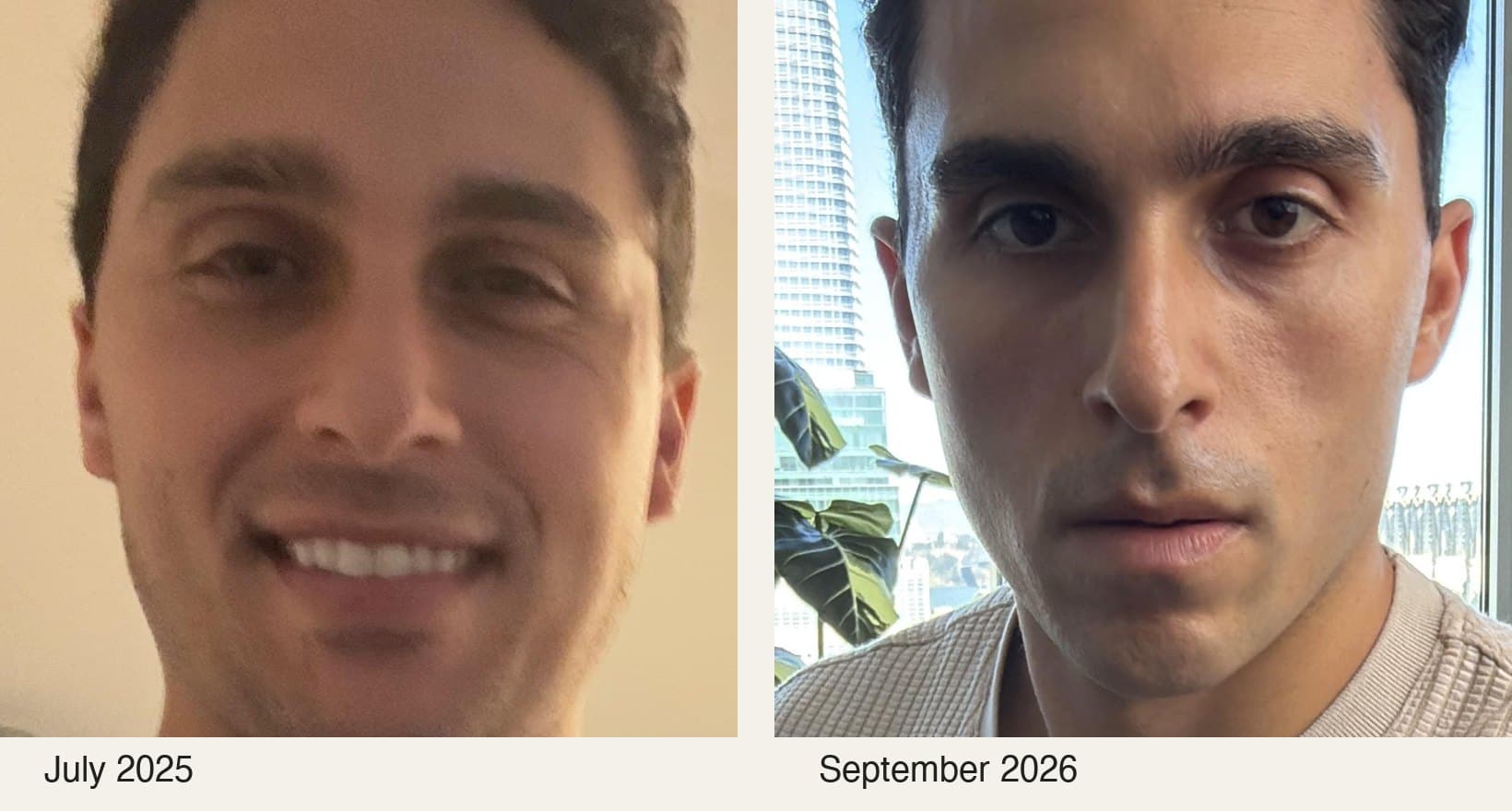
About 60 days in, my skin was brighter, the texture was smoother, and my fine lines and wrinkles were visibly better. By six months the biggest change was plumpness. My skin looked like it had more collagen in it.
How to Run This on Yourself
Don’t copy my panel. Copy the test. My rule for any experiment is simple: get baseline labs, write down the thing you’re trying to fix, change one thing when you can, track what happens, retest. If it didn’t work, say it didn’t work and stop forcing the theory.
- Measure first. Get a morning cortisol test (or whatever your target is) before you buy anything.
- Pick a time and keep it. The eye study only worked in the morning. My sessions were a daily habit, fifteen minutes with a Hooga panel running 660 nm red and 850 nm near-infrared.
- Give it 90 days. One good morning tells you nothing.
- Retest the same way. Same lab, same time of day. For skin, take photos in the same light every month.
- Protect your eyes. The eye study used a gentle, low-power device for three minutes. A full panel puts out many times more light, so use the goggles it comes with.
Fifteen minutes a day. My clock got its morning signal back, my eyes get their dose, and my skin gets the power to do the repair work. All for looking like a rotisserie chicken.
References
- Ho Mien, I. et al. “Effects of exposure to intermittent versus continuous red light on human circadian rhythms, melatonin suppression, and pupillary constriction.” PLOS ONE, 9(5):e96532 (2014).
- Figueiro, M. G. & Rea, M. S. “The effects of red and blue lights on circadian variations in cortisol, alpha amylase, and melatonin.” International Journal of Endocrinology, 2010:829351 (2010).
- Shinhmar, H., Hogg, C., Neveu, M. & Jeffery, G. “Weeklong improved colour contrasts sensitivity after single 670 nm exposures associated with enhanced mitochondrial function.” Scientific Reports, 11:22872 (2021).
- Wunsch, A. & Matuschka, K. “A controlled trial to determine the efficacy of red and near-infrared light treatment in patient satisfaction, reduction of fine lines, wrinkles, skin roughness, and intradermal collagen density increase.” Photomedicine and Laser Surgery, 32(2):93–100 (2014).
- Mota, L. R. et al. “Photobiomodulation reduces periocular wrinkle volume by 30%: a randomized controlled trial.” Photobiomodulation, Photomedicine, and Laser Surgery, 41(2):48–56 (2023).
- Pickart, L. & Margolina, A. “Regenerative and protective actions of the GHK-Cu peptide in the light of the new gene data.” International Journal of Molecular Sciences, 19(7):1987 (2018).
- National Institute of General Medical Sciences. “Circadian Rhythms” fact sheet.